After my time at residential school - in fact on the last morning I wondered aloud to the course director if I should take S103 or not.
On the plus side, it would be good experience working in a more long term course, TMA (tutor marked assignments) and having a tutor would all be good experience.
I had looked into the idea of credit transfer, but for that it needed certain documents to show what I already had, and although I could probably find my degree certificate within a day or two of rummaging, the details of the modules and courses I did I don't think I have any record of.
On the other hand, I ought to be able to do the course quite easily, having done a science degree and having found the other courses I'd done at level one not too hard. And then again it was like £560 pounds to do it - not the sort of sum you casually toss around on a whim.
In the end, I decided to do it. My geology and chemistry were a little weak, I wasn't sure how much biology and physics I might have forgotten, and I had a feeling that doing things the OU way would be useful.
The deciding factor was that in September, none of the level 2 courses I was interested in were running, they all started in the following February. So, I decided I'd sign up, get the 60 points on offer (hopefully). I'd also work hard to get as far ahead as I could, and if things were going well, I could sign up for a course in Feb to run parallel with the 2nd half of S103.
It seemed like a plan.
Saturday, 26 August 2006


Tuesday, 25 July 2006
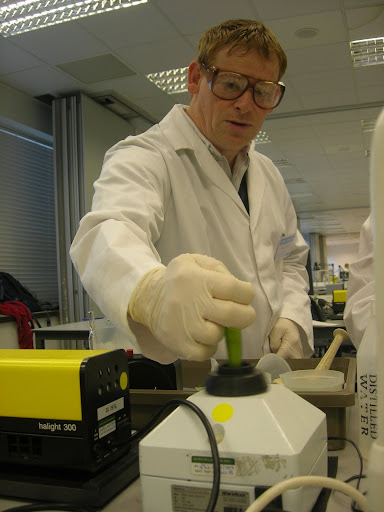
Back from the residential school
Back from the school, and starting to recover. I have an ECA (End of Course Assessment) in my hand, that needs to be completed with about a month.
The advice at the school was to do this as soon as you can, as a lot of the questions focus on the practical work you did, and your memory for the details fades quickly.
I had to write up one of the physics experiments and draw graphs, do some analysis of ecology data and a few other things. It wasn't that hard, but did take a day or two to get it all down.
With the ECA posted, we just had to sit back and wait. It takes a long time for it to be marked. I did the school in mid July, and got the result a few days before Christmas. By that time I couldn't remember much about it or where I might have gone wrong. I scored 77% for this one, which I was vaguely annoyed about. I thought I'd done better than that, and the feedback was of the general nature across all answers "Students answer this question well on the whole, those that failed ..."
Anyway, I decided by this time to just write it off, although I heard from one or two of my fellow students that they too were surprised at the level of the mark.
Onwards...
The advice at the school was to do this as soon as you can, as a lot of the questions focus on the practical work you did, and your memory for the details fades quickly.
I had to write up one of the physics experiments and draw graphs, do some analysis of ecology data and a few other things. It wasn't that hard, but did take a day or two to get it all down.
With the ECA posted, we just had to sit back and wait. It takes a long time for it to be marked. I did the school in mid July, and got the result a few days before Christmas. By that time I couldn't remember much about it or where I might have gone wrong. I scored 77% for this one, which I was vaguely annoyed about. I thought I'd done better than that, and the feedback was of the general nature across all answers "Students answer this question well on the whole, those that failed ..."
Anyway, I decided by this time to just write it off, although I heard from one or two of my fellow students that they too were surprised at the level of the mark.
Onwards...
Friday, 14 July 2006
Off to residential school
While working on my planets and fossils courses, the residential school material arrived.
I finished and submitted the planets/fossils so had plenty of time to read through the preparatory material, and get a copy of the good sciences guide to read too.
I found this second book very boring to read - partly because you shouldn't read it as a book, but use it to help you with specific topics. I also knew a fair bit about it.
I did worry before hand if I could tackle SXR103 without doing the main course, S103, but in the end decided my previous science experience would carry me through. The course was advertised as a standalone one, but it seems to have been a fairly recent change (last few years) so I wondered if it was just for the purposes of advertising.
I'm not going to write up my experiences, as I've already done so else where.
See the informal account and the more formal account I modified so the OU could use it directly.
I finished and submitted the planets/fossils so had plenty of time to read through the preparatory material, and get a copy of the good sciences guide to read too.
I found this second book very boring to read - partly because you shouldn't read it as a book, but use it to help you with specific topics. I also knew a fair bit about it.
I did worry before hand if I could tackle SXR103 without doing the main course, S103, but in the end decided my previous science experience would carry me through. The course was advertised as a standalone one, but it seems to have been a fairly recent change (last few years) so I wondered if it was just for the purposes of advertising.
I'm not going to write up my experiences, as I've already done so else where.
See the informal account and the more formal account I modified so the OU could use it directly.
Friday, 26 May 2006
The Planets
I've always had an interest in planets, and this course seemed like an ideal opportunity to explore this more. I mean, I knew what they were all called, and where they were more or less, I'd even seen Partick Moore talk about them live.
It came with
The course looks at each of the 9 (as there were when I started it, but not by the end!) planets, and other solar system objects in detail, and a final chapter on planets around other systems.
Besides the basic facts or orbits and moons, there is a fair bit about the geology of each planet, or at least as much as is known.
The multi choice CMA at the end is harder than it sounds. Some of the questions it is quite hard to argue for which ones are right. I found one of them seemed to hinge on exactly what a planetary body was - the course books themselves have 3 different definitions.
Anyway, another 10 points accumulated.
It came with
- A course book
- A Teach Yourself Planets book (always referred to as TYP).
- A CD with images and facts on
- A couple of Computer Marked Assignments.
The course looks at each of the 9 (as there were when I started it, but not by the end!) planets, and other solar system objects in detail, and a final chapter on planets around other systems.
Besides the basic facts or orbits and moons, there is a fair bit about the geology of each planet, or at least as much as is known.
The multi choice CMA at the end is harder than it sounds. Some of the questions it is quite hard to argue for which ones are right. I found one of them seemed to hinge on exactly what a planetary body was - the course books themselves have 3 different definitions.
Anyway, another 10 points accumulated.
Wednesday, 24 May 2006
Fossils and the history of life
Another large cardboard box arrived.
Now this one had
Its a fascinating course as we move from no life, to early life to the cambrian explosion and so on.
Then horror of horror, you have to use the supplied fossils with a supplied hand lens, and SKETCH them. Draw? DRAW? Don't they know I can barely write these days and I do all my work on computers? I've never been much good at drawing, so this is a bit of a shock!
I make a valiant stab at it - but lets face it, it wont win any prizes!
There is also confusion about the difference between bivalves and brachiopods - the rules seem simple but the most common of fossils flaunts the rule cruelly.
Anyway, this course finishes with a CMA (Computer marked assignment) so its pick one of A,B,C,D,E,F etc, or in some cases two or three. So there is no worry about getting the words right - but the questions are a lot more difficult than they sound.
Anyway - this one you can submit online if you like, so I did that, and passed he course. Another one down!
Now this one had
- A course book
- A colourful atlas of ancient life
- A couple of ECA papers
- A DVD
- Some notes
- A pack of fossil casts
Its a fascinating course as we move from no life, to early life to the cambrian explosion and so on.
Then horror of horror, you have to use the supplied fossils with a supplied hand lens, and SKETCH them. Draw? DRAW? Don't they know I can barely write these days and I do all my work on computers? I've never been much good at drawing, so this is a bit of a shock!
I make a valiant stab at it - but lets face it, it wont win any prizes!
There is also confusion about the difference between bivalves and brachiopods - the rules seem simple but the most common of fossils flaunts the rule cruelly.
Anyway, this course finishes with a CMA (Computer marked assignment) so its pick one of A,B,C,D,E,F etc, or in some cases two or three. So there is no worry about getting the words right - but the questions are a lot more difficult than they sound.
Anyway - this one you can submit online if you like, so I did that, and passed he course. Another one down!
Saturday, 1 April 2006
What to do next?
With genetics done, and a bit more confidence in my abilities, the course material, and starting to work out how everything came together at the OU, I looked around to see what else I might tackle.
There are quite a number of science short courses that are of a similar length to the SK195 one.
I had a look at what was on offer.
Quite a number - but I needed one that started in May. Also after considering the speed I did the SK195, I probably ought to be able to manage two at the same time.
So - after a bit of deliberation, I picked the S196 Planets: An Introduction course, and the S193 Fossils and the History of Life courses.
Also at this time - I looked at the various degree options and what these courses could count for - if anything! It was soon obvious that to get any science named degree it required the basic science foundation course S103 Discovering Science and the associated residential school SXR103 Practising Science.
The main course didn't start until September, but it said you could take the residential course without it. So that's what I decided to do. After all - there are only 3-4 residential weeks in a year, so you have to measure those carefully if you want a degree in a short time.
So - a new plan for the rest of 2006.
Planets and Fossils short courses, then the residential school, then see what the options are. Probably S103.
There are quite a number of science short courses that are of a similar length to the SK195 one.
I had a look at what was on offer.
Quite a number - but I needed one that started in May. Also after considering the speed I did the SK195, I probably ought to be able to manage two at the same time.
So - after a bit of deliberation, I picked the S196 Planets: An Introduction course, and the S193 Fossils and the History of Life courses.
Also at this time - I looked at the various degree options and what these courses could count for - if anything! It was soon obvious that to get any science named degree it required the basic science foundation course S103 Discovering Science and the associated residential school SXR103 Practising Science.
The main course didn't start until September, but it said you could take the residential course without it. So that's what I decided to do. After all - there are only 3-4 residential weeks in a year, so you have to measure those carefully if you want a degree in a short time.
So - a new plan for the rest of 2006.
Planets and Fossils short courses, then the residential school, then see what the options are. Probably S103.
Subscribe to:
Posts (Atom)

 Posts
Posts


