Another largish tomb to digest. Book 5 is all about plants.
It starts off with the simplest of plants like mosses and so on, and works its way through the whole field. There is quite a lot of detail, and the start of the book I find rather heavy going as it introduces all the different types and their various ways of reproducing. Its a lot of alphabet soup here as all manner of new terms and structures are described in quick succession. Everything under the sun has a new somethingaphore or blastothingy
However it does get into more of the stuff I like, such as the mechanisms of photosystems and the molecular detail of transport systems and such like. Yes, I know I'm weird but thanks for asking! CAM and C4 plants also get a mention - you'd have though RuBisCO would have sorted itself out by now, I mean its had several hundred million years to get it right, if not several billion!
Then we get into water transport, stomata and xylem, followed by phloem and sugar transport and all that stuff. There is a lot of detail on this and its all quite interesting, but again there are a lot of words to learn. Sieve tubes, companion cells, pressure-flow, cohesion-tension theories etc.
After that we explore the flowering mechanisms, and also re-examine the auxin theory of phototropism. This has changed substantially since I last looked at it, it seems the early researchers came to premature conclusions based on reasonable evidence.
It rounds off with a section on microbes, seeds and interactions between them.
Tuesday, 7 August 2007


Friday, 27 July 2007
SXR270 - day 7
The last day!
Breakfast and packing, whilst trying to get over the "staying up until past 2:00am at the disco and possibly having imbibed a little more than one is use to" feeling.
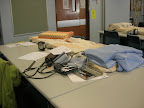
Anyway, happily this is about feedback and control systems in the body, and we're looking at blood pressure and pulse rates. We start by measuring resting blood pressure and pulse rates. Then, given our state, we decide to test the hypothesis that they will decrease if we lie down for a few minutes. We all try that out, and then move on to other scenarios. Maybe caffeine in the coffee at coffee break has an effect, we test that out. Others look at exercise and also lying head down and standing on their heads and so on. Still feeling a little rough, we decide standing on ones head is probably going to end in a certain amount of disaster, so we continue with the lieing down theme.
 I manage to sidetrack the tutor into a discussion on the comparative anatomy of the crocodilian three chambered heart, and how a giraffe manages its blood pressure. Then, a debriefing followed by a bit of theory on the heart and one of the people is hooked up to an ECG. We compare heart rates with breathing cycles and also the effect of holding your breath on the heart pumping mechanics. Finally, the tutor shows us the dive response by wiring himself up, and then plunging his face into a bowl of iced water! What a way to end!!
The final lunch, and then the final briefing to the whole school about the ECA and then we got the ECA and that was that!
Once you leave campus, the real world starts to filter back in and the residential school starts to seem more like a dream. For that week you are isolated from most of the world, I saw no TV, read no newspapers, and really had little idea what was going on outside the course (and was probably better for it!). So focused you are in the course, its hard to get much time for normal things. Some people attempted TMAs and things while there, but I don't think many were done.
With a typical day (for me anyway) starting with getting up at 7ish, walking into breakfast at about 7:45, chatting with others, then we assembled at about 8:30 for the walk to the QMC for a 9:00 start. Labs from 9-12:30 or so, lunch 12:30-1:30, labs 1:30-5, tea at 5:45, briefings and other sessions 7:00-9:00, bar from 9:00-whenever. Its a full day!
Breakfast and packing, whilst trying to get over the "staying up until past 2:00am at the disco and possibly having imbibed a little more than one is use to" feeling.
Anyway, happily this is about feedback and control systems in the body, and we're looking at blood pressure and pulse rates. We start by measuring resting blood pressure and pulse rates. Then, given our state, we decide to test the hypothesis that they will decrease if we lie down for a few minutes. We all try that out, and then move on to other scenarios. Maybe caffeine in the coffee at coffee break has an effect, we test that out. Others look at exercise and also lying head down and standing on their heads and so on. Still feeling a little rough, we decide standing on ones head is probably going to end in a certain amount of disaster, so we continue with the lieing down theme.
 I manage to sidetrack the tutor into a discussion on the comparative anatomy of the crocodilian three chambered heart, and how a giraffe manages its blood pressure. Then, a debriefing followed by a bit of theory on the heart and one of the people is hooked up to an ECG. We compare heart rates with breathing cycles and also the effect of holding your breath on the heart pumping mechanics. Finally, the tutor shows us the dive response by wiring himself up, and then plunging his face into a bowl of iced water! What a way to end!!
The final lunch, and then the final briefing to the whole school about the ECA and then we got the ECA and that was that!
Once you leave campus, the real world starts to filter back in and the residential school starts to seem more like a dream. For that week you are isolated from most of the world, I saw no TV, read no newspapers, and really had little idea what was going on outside the course (and was probably better for it!). So focused you are in the course, its hard to get much time for normal things. Some people attempted TMAs and things while there, but I don't think many were done.
With a typical day (for me anyway) starting with getting up at 7ish, walking into breakfast at about 7:45, chatting with others, then we assembled at about 8:30 for the walk to the QMC for a 9:00 start. Labs from 9-12:30 or so, lunch 12:30-1:30, labs 1:30-5, tea at 5:45, briefings and other sessions 7:00-9:00, bar from 9:00-whenever. Its a full day!
Thursday, 26 July 2007
SXR270 - day 6
Thursday - and its a new activity. Regulation and control.

We start off the morning looking at samples of blood glucose taken from various patients doing various things, including a type II diabetic. This is a lot of work with automatic pipettes and test tubes. After filling 48 tubes with various mixtures we then have to add detection enzymes and run the tubes through a colorimeter. This allows the amount of glucose to be recorded, once we have plotted a graph of controlled samples to calibrate the device. However with 48 different tubes and labels, its quite easy to get a bit confused on the 32nd or so and miss your place, so care is needed.
Its a fairly gentle exercise and takes us up to lunch.
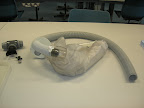
After lunch we go into a different lab and start to play with Douglas bags. These are large plastic bags that will capture your exhaled air which can then be analysed and measured.
We start by using them to try and work out a basal metabolic rate. After we have this, we move onto looking at effects, such as exercise, caffeine intake, chocolate, smoking and so on.
This can then be compared against the base value and we can see the sort of effect it has on you.
After the day is done, there is the option to go and have a look at the level 3 labs and see what they do in those. It looks a little daunting in some respects, and you have to pass a test even before starting. However most people seem to be getting on with it ok.
Tea - then a free evening, and after a certain amount of internal debate I decided to get a disco ticket. We hung around in the Cripps bar until about 10ish, then wandered down to the portland building. People started arriving in significant numbers after a few minutes, and soon some brave souls, lead by the course director, were dancing.
We partied on into the night. Later on some more of the double-blues turned up, including jiving Jonathan. We all got into the spirit - in more ways than one by then. It all wound up at 1am, despite saying 9:30-1:30 on the ticket. One or two of our party went and had a quiet word with the DJ while the rest of us ran for cover fearing the fallout.
We retired back to hall and continued for a while trying to keep quiet in a room. The smokers finally broke rank and I went to bed just after 2:00am.

We start off the morning looking at samples of blood glucose taken from various patients doing various things, including a type II diabetic. This is a lot of work with automatic pipettes and test tubes. After filling 48 tubes with various mixtures we then have to add detection enzymes and run the tubes through a colorimeter. This allows the amount of glucose to be recorded, once we have plotted a graph of controlled samples to calibrate the device. However with 48 different tubes and labels, its quite easy to get a bit confused on the 32nd or so and miss your place, so care is needed.
Its a fairly gentle exercise and takes us up to lunch.
After lunch we go into a different lab and start to play with Douglas bags. These are large plastic bags that will capture your exhaled air which can then be analysed and measured.
We start by using them to try and work out a basal metabolic rate. After we have this, we move onto looking at effects, such as exercise, caffeine intake, chocolate, smoking and so on.
This can then be compared against the base value and we can see the sort of effect it has on you.
After the day is done, there is the option to go and have a look at the level 3 labs and see what they do in those. It looks a little daunting in some respects, and you have to pass a test even before starting. However most people seem to be getting on with it ok.
Tea - then a free evening, and after a certain amount of internal debate I decided to get a disco ticket. We hung around in the Cripps bar until about 10ish, then wandered down to the portland building. People started arriving in significant numbers after a few minutes, and soon some brave souls, lead by the course director, were dancing.
We partied on into the night. Later on some more of the double-blues turned up, including jiving Jonathan. We all got into the spirit - in more ways than one by then. It all wound up at 1am, despite saying 9:30-1:30 on the ticket. One or two of our party went and had a quiet word with the DJ while the rest of us ran for cover fearing the fallout.
We retired back to hall and continued for a while trying to keep quiet in a room. The smokers finally broke rank and I went to bed just after 2:00am.
Wednesday, 25 July 2007
SXR270 - day 5
Wow - those days keep rolling by!
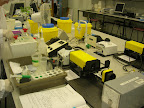
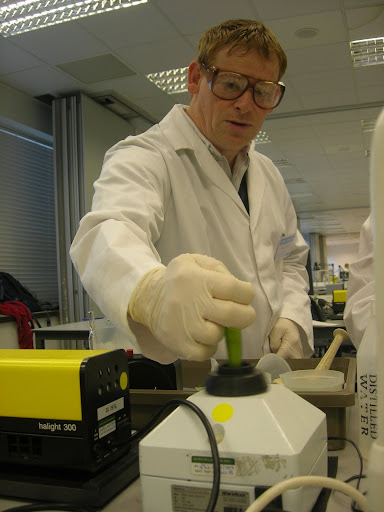
We started this morning after breakfast in the plant lab again. This time we ground up some plant leaves to extract the chloroplasts. This involved a pestle and mortar, an extraction buffer, a couple of trips to the centrifuge, and quite a lot of ice to keep them from degrading. It was also our first encounter with whizzy stirrers.
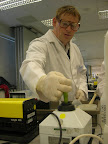
Once we had prepared the extraction, we used DCTIP to check that we had captured chloroplasts and that things were working. This is a die that is blue, but turns colourless as it hijacks the electrons produced from the photosystem electron transfer chains. Extremely convenient as it shows you photosynthesis in action.

First we measured the degradation of the die with white light. Then we tried a few different filters to see the effect red, green, blue, orange and yellow light had on the rate of photosynthesis.
Plotting these on a graph showed the light colours that were best absorbed with the steepest lines.
Red and blue are favourites, green not very good and orange, yellow and light somewhere in between. So that's why plants are green - they absorb the rest.
Other groups tried light intensity variations which showed an increase with increasing light - up to a point. Photooxidation then starts to kick in as the leaves get more light than they can handle. We have a debrief on this session which ends with Rachel posing us the question "why aren't plant leaves black and so absorbing all light wavelengths?"
Lunch was followed by a poster session. We had two hours to make a scientific poster on any of the activities we had done with plants. I did mine on the results from yesterdays lime leaves which gave some rather fine data. As usual, for me, I had about finished it after 30 minutes, but then all the little touching up and fiddling around and reprinting took another hour or so. I asked Rachel why plants are green, to which she suggested it was to do with not absorbing too much light and so causing overheating.
Eventually my poster was as done as it was ever going to be, and it was framed in a big sleeve and pinned up on a set of display boards.
I went back to Rachel unconvinced about the black/green plant leaf explanation, challenging her on plants in low light environments like forest floors and Arctic tundra. Finally I found something she couldn't answer! Boy that was hard work, she had an answer for everything else!!
Then back to the room to crash out for a while until tea, then its back to the QMC to do poster viewing.
We looked and commented on our own posters after a break, and also at all the others in the group. Then we went on to look at the other groups and see what they looked like. It was quite useful in some ways. You got to see posters with bits in that you thought you'd done better. You also saw some ideas you wish you'd have thought of too. Still - in the end I was satisfied with my efforts, and the feedback was fairly good too. I made some rather light hearted remarks on the feedback form, not realising they would be collected in. I hope it doesn't count against me!!
We decided to go to Lenton bar tonight and had a few drinks there. After we returned I thought I'd just poke my nose into Cripps bar to see what was going on, and somehow got into a discussion on Tim's view of exactly what risk assessment means to him (everything apparently!).
We started this morning after breakfast in the plant lab again. This time we ground up some plant leaves to extract the chloroplasts. This involved a pestle and mortar, an extraction buffer, a couple of trips to the centrifuge, and quite a lot of ice to keep them from degrading. It was also our first encounter with whizzy stirrers.
Once we had prepared the extraction, we used DCTIP to check that we had captured chloroplasts and that things were working. This is a die that is blue, but turns colourless as it hijacks the electrons produced from the photosystem electron transfer chains. Extremely convenient as it shows you photosynthesis in action.

First we measured the degradation of the die with white light. Then we tried a few different filters to see the effect red, green, blue, orange and yellow light had on the rate of photosynthesis.
Plotting these on a graph showed the light colours that were best absorbed with the steepest lines.
Red and blue are favourites, green not very good and orange, yellow and light somewhere in between. So that's why plants are green - they absorb the rest.
Other groups tried light intensity variations which showed an increase with increasing light - up to a point. Photooxidation then starts to kick in as the leaves get more light than they can handle. We have a debrief on this session which ends with Rachel posing us the question "why aren't plant leaves black and so absorbing all light wavelengths?"
Lunch was followed by a poster session. We had two hours to make a scientific poster on any of the activities we had done with plants. I did mine on the results from yesterdays lime leaves which gave some rather fine data. As usual, for me, I had about finished it after 30 minutes, but then all the little touching up and fiddling around and reprinting took another hour or so. I asked Rachel why plants are green, to which she suggested it was to do with not absorbing too much light and so causing overheating.

Eventually my poster was as done as it was ever going to be, and it was framed in a big sleeve and pinned up on a set of display boards.
I went back to Rachel unconvinced about the black/green plant leaf explanation, challenging her on plants in low light environments like forest floors and Arctic tundra. Finally I found something she couldn't answer! Boy that was hard work, she had an answer for everything else!!
Then back to the room to crash out for a while until tea, then its back to the QMC to do poster viewing.
We looked and commented on our own posters after a break, and also at all the others in the group. Then we went on to look at the other groups and see what they looked like. It was quite useful in some ways. You got to see posters with bits in that you thought you'd done better. You also saw some ideas you wish you'd have thought of too. Still - in the end I was satisfied with my efforts, and the feedback was fairly good too. I made some rather light hearted remarks on the feedback form, not realising they would be collected in. I hope it doesn't count against me!!
We decided to go to Lenton bar tonight and had a few drinks there. After we returned I thought I'd just poke my nose into Cripps bar to see what was going on, and somehow got into a discussion on Tim's view of exactly what risk assessment means to him (everything apparently!).
Tuesday, 24 July 2007
SXR270 - day 4
Day four - and we move on to theme 3, the plants one.
After the briefing the night before, we were urged to find some interesting plant leaves from anywhere we could to compare carbon uptake. This is a recurring idea in the course. Unlike SXR103 where you sort of just follow a script, here you have to make your own hypotheses and can even devise your own experiments within certain boundaries.
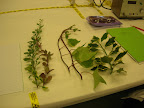
Anyway, Cheryl had this great idea to find some holly and some ivy, and then we could make a bit of a theme if we wrote it up as a poster. However it took a while to track down some ivy. We eventually found some half way to the lab.
In the lab after a briefing we decided to subject the variegated holly to the carbon 14 test. We picked bits of the leaf that were yellow to compare with green bits. After a few background counts we subjected the leaf discs to about 20 mins of 14C exposure, and then started to look at the results with a GM tube. The discs we had cut were quite small so the results were not much above background rates. Background was around 30, and we were getting 50-60 on the green bits. The t-test showed these results as significant.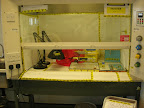
After this, we tried some lime leafs - one of which was growing in sunlight, the other in shade. This was far more dramatic. The shaded leafs gave counts of 3600, and those in the light around 700. After we did the maths the results were highly significant. Some good results!
We finished up the morning by looking at leaf impressions that showed the stomata under a microscope to see if we could see the structures.
So the holly and the ivy theme sort of disappeared.
After lunch, we moved onto stomatal control, looking at the effects of light, dark, CO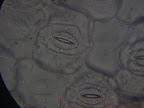 2 and ABA on the opening of stomata. We had to peal epidermal layers off a leaf and then subject them to the various conditions. Results were rather disappointing not really leading to very solid conclusions. Some of them went the way the text book and tutors expected, but with quite small margins. Others went the opposite way. We weren't really clear what went wrong, or if we had discovered something new! However it seemed it wasn't the first time this had happened.
The tea, and a debrief on the days experiments, followed by a briefing on the next days experiment. Then a session roughing out a design for a scientific poster to be done tomorrow. Rachel the activity tutor was like a walking encyclopaedia of latin names for plants. She just kept reeling them off.
Then to the bar for further discussion!
After the briefing the night before, we were urged to find some interesting plant leaves from anywhere we could to compare carbon uptake. This is a recurring idea in the course. Unlike SXR103 where you sort of just follow a script, here you have to make your own hypotheses and can even devise your own experiments within certain boundaries.
Anyway, Cheryl had this great idea to find some holly and some ivy, and then we could make a bit of a theme if we wrote it up as a poster. However it took a while to track down some ivy. We eventually found some half way to the lab.
In the lab after a briefing we decided to subject the variegated holly to the carbon 14 test. We picked bits of the leaf that were yellow to compare with green bits. After a few background counts we subjected the leaf discs to about 20 mins of 14C exposure, and then started to look at the results with a GM tube. The discs we had cut were quite small so the results were not much above background rates. Background was around 30, and we were getting 50-60 on the green bits. The t-test showed these results as significant.
After this, we tried some lime leafs - one of which was growing in sunlight, the other in shade. This was far more dramatic. The shaded leafs gave counts of 3600, and those in the light around 700. After we did the maths the results were highly significant. Some good results!
We finished up the morning by looking at leaf impressions that showed the stomata under a microscope to see if we could see the structures.
So the holly and the ivy theme sort of disappeared.
After lunch, we moved onto stomatal control, looking at the effects of light, dark, CO
 2 and ABA on the opening of stomata. We had to peal epidermal layers off a leaf and then subject them to the various conditions. Results were rather disappointing not really leading to very solid conclusions. Some of them went the way the text book and tutors expected, but with quite small margins. Others went the opposite way. We weren't really clear what went wrong, or if we had discovered something new! However it seemed it wasn't the first time this had happened.
The tea, and a debrief on the days experiments, followed by a briefing on the next days experiment. Then a session roughing out a design for a scientific poster to be done tomorrow. Rachel the activity tutor was like a walking encyclopaedia of latin names for plants. She just kept reeling them off.
Then to the bar for further discussion!
Monday, 23 July 2007
SXR270 - day 3
Day three starts with us in breakfast consoling ourselves about not winning in the quiz last night.
Then - after the walk to the QMC, we're back in the lab, this time looking at cells from manduca sexta.
They eat a diet rich in potassium, so they get a lot of K+ in their diet, which they have to manage. A lot of this enters their system, and they have to get it out again before it messes up their internals.
We hypothesised that there was some sort of active transport going on here, to pump the ions back out.

We started our day by looking at the pH values of the various stages of the gut, food and faeces of the worm, and also its internal hemolymph system. This is because one hypothesis is that there is a H+/K+ antiporter. If this is the case then the pH should change as protons are pumped in exchange for K+ ions.
We then went on to measure electrical potential across the gut wall using a small piece of tissue held in a clamp between two solutions. We altered the potassium concentration to try and see what rate it could pump the ions, and we also used an electron transport chain blocking substance dinitrophenol to disable ATP synthesis and to see if that stopped the pumping and so gave evidence for an energy hungry transport reaction.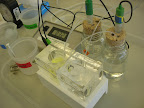
Another group look at sections of tissue under the microscope and also electron-micrographs to look for clues in the histology of the cells.
After lunch we had to prepare a five minute presentation with slides about some aspect of the work we had done over the past two days. Sue and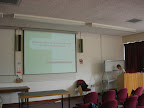 I did a presentation on oxygen uptake differences between skin and muscle cells based on the data we found yesterday.
Others did similar sorts of things, or ones based around the manduca investigation. There was a lot of good stuff there, but with the best will in the world, by the time you'd heard the 10th presentation on oxygen uptake in muscle v. liver, it began to pale a little.
Once that was done and we'd listened to all the talks, we went back for tea, just beating the rain.
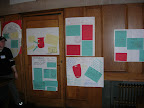 After tea, a briefing on the next days activity, photosynthesis. We also had a partner shuffle.
This was followed by a poster session where we had 20 minutes to make a poster based on a rather sketchy experimental report. We did it in 10! That probably wasn't the point though!
A night in the bar listening (and avoiding) to the karaoke, but chatting with our next lab partners and some friends.
A pretty early night really.
Then - after the walk to the QMC, we're back in the lab, this time looking at cells from manduca sexta.
They eat a diet rich in potassium, so they get a lot of K+ in their diet, which they have to manage. A lot of this enters their system, and they have to get it out again before it messes up their internals.
We hypothesised that there was some sort of active transport going on here, to pump the ions back out.

We started our day by looking at the pH values of the various stages of the gut, food and faeces of the worm, and also its internal hemolymph system. This is because one hypothesis is that there is a H+/K+ antiporter. If this is the case then the pH should change as protons are pumped in exchange for K+ ions.
We then went on to measure electrical potential across the gut wall using a small piece of tissue held in a clamp between two solutions. We altered the potassium concentration to try and see what rate it could pump the ions, and we also used an electron transport chain blocking substance dinitrophenol to disable ATP synthesis and to see if that stopped the pumping and so gave evidence for an energy hungry transport reaction.
Another group look at sections of tissue under the microscope and also electron-micrographs to look for clues in the histology of the cells.
After lunch we had to prepare a five minute presentation with slides about some aspect of the work we had done over the past two days. Sue and
 I did a presentation on oxygen uptake differences between skin and muscle cells based on the data we found yesterday.
Others did similar sorts of things, or ones based around the manduca investigation. There was a lot of good stuff there, but with the best will in the world, by the time you'd heard the 10th presentation on oxygen uptake in muscle v. liver, it began to pale a little.
Once that was done and we'd listened to all the talks, we went back for tea, just beating the rain.
 After tea, a briefing on the next days activity, photosynthesis. We also had a partner shuffle.
This was followed by a poster session where we had 20 minutes to make a poster based on a rather sketchy experimental report. We did it in 10! That probably wasn't the point though!
A night in the bar listening (and avoiding) to the karaoke, but chatting with our next lab partners and some friends.
A pretty early night really.
Subscribe to:
Posts (Atom)

 Posts
Posts


