Block 8 - and its wall to wall chemistry.
After the horrors of Block 7 several people found this a bit easier, and some didn't. There are apparently two points in this course when people give up. The first is when they receive the first lot of course material and realise what they have let themselves in for.
The second is about this point when the first of the optional TMA's is presented. The course has been picking up momentum to this point, and I guess its a make or break point. If you had been struggling up to this point, this is probably the straw that breaks the donkeys back.
Anyway, the course covers
Electron orbital theory, then into chemical bonding types.
A chapter on chemical reactions and energy changes, and then a look at taht werid molecule water. This is followed up by discussing chemical equilibrium, and a bit about acids and bases, then its back to rates of chemical reactions, with a brief detour into industrial reactions.
Finally a forrey into organic chemistry, and a look at functional groups and their reactions, rounded of by chapters on polymers and pharmaceuticals.
I found it all very interesting and it left me with more questions than answers in some ways, as only the basics were covered - so I was always left wondering "Yes, but why..."
For the TMA the first question came from block 7. However I found it very easy compared to the depth of material in there. I think I could have answered most of it without reading block 7. There was a bit about energy absorption and emission spectrum's, transmutation of elements and a little bit on half-lifes.
Question 2 was chemical bonding, and drawing structural and lewis formats for bonding.
Question 3 was about pH of acids, and involved calculating the pH of a given solution.
Question 4 got you to explain an industrial reaction with relation to Le Chatelier’s principle, and talk a little about catalysts. This was a descriptive piece mostly.
Question 5 was about polymers, and you had to draw some polymers and report the type of polymerisation being done. Functional groups also had to be labelled.
I didn't find this TMA too difficult, although my dislike of essays didn't help with question 4.
Sunday, 11 March 2007


Thursday, 1 March 2007
S204: Book 2 - Generating Diversity
Onwards to book two. Book two is a bit of a mixture - its called Generating Diversity and has quite a mix of chapters.
Chapter 1 is about surviving the winter, and the various strategies that organisms can use to get through that period. It covers things like hibernation, scavenging, and so on.
Chapter 2 looks at food and the various strategies available. Carniovores, herbivores, how digestion works and how often feeding is required.
Chapter 3 looks at diversity through natural selection and the sources of variation.
Chapter 4 is about reproduction, and covers all manner of different breeding strategies, from asexual to sexual and a number of other ways in between.
Chapter 5 is about defence and covers things like immunology, pathogens and so on.
Chapter 6 covers longevity and looks at the causes of death, the trade offs of a longer life and so on.
As I said, its a bit of a mixture, covering a lot of ground. Naturally there is a TMA on this material... It was an interesting book to read, as if you didn't like a particular subject much, it soon changed.
Chapter 1 is about surviving the winter, and the various strategies that organisms can use to get through that period. It covers things like hibernation, scavenging, and so on.
Chapter 2 looks at food and the various strategies available. Carniovores, herbivores, how digestion works and how often feeding is required.
Chapter 3 looks at diversity through natural selection and the sources of variation.
Chapter 4 is about reproduction, and covers all manner of different breeding strategies, from asexual to sexual and a number of other ways in between.
Chapter 5 is about defence and covers things like immunology, pathogens and so on.
Chapter 6 covers longevity and looks at the causes of death, the trade offs of a longer life and so on.
As I said, its a bit of a mixture, covering a lot of ground. Naturally there is a TMA on this material... It was an interesting book to read, as if you didn't like a particular subject much, it soon changed.
Saturday, 24 February 2007
S204: Experimental Week
Biology has a high amount of practical work to prove mechanisms and pathways, so there is an experimental strand to the S204 course. We are about to start on the first week of this, with investigative week one.
The task, should we decide to accept it - and the fact it will be examine in the mandatory TMA-2 is a good indication that one should, is to look in detail at the breakdown on hydrogen peroxide into water and oxygen. There is a enzyme catalyst for this reaction found in many living cells, as it is part of the chain that disposes of oxygen free radicals. In this case, we're going to get them from a simple source, the humble potato. The experiment also involves buying some H2O2 which causes some interest. This is one of the alleged substances that the terrorists were planning to use in their liquid bombs, so a raised eyebrow is not uncommon when asking for some at a chemists.
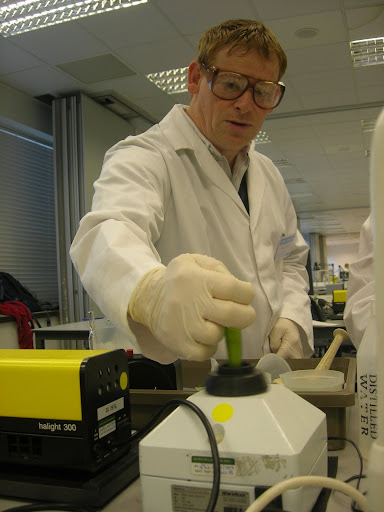
 We have been sent an experimental kit, which consists mostly of test tubes with rubber bungs and glass pipes in them. Also supplied are pipettes and safety glasses. I elected to wear the glasses in the first part of the experiment as I'm sure it made me look more like a proper scientist.
The potato has to be liquidised to get at the enzyme, and then left to separate into a rather unappealing mess. Also the hydrogen peroxide, various containers of water and a stopwatch are required, as is a notebook to record all the results.
Experiment one is to try and find a mixture of this potato juice, water and hydrogen peroxide that reacts at a reasonable rate. Not so fast that it sprays all over the kitchen, and not so slow that it drips at an uncountable rate. It takes a bit of practice to assemble the components in a timely manner so that drips can be counted, that give an indication how fast the breakdown is occurring.
Experiment 2 is to repeat the experiment a number of times with the chosen mixture, and see at what time the peak production occurs.
Experiment 3 looks at varying the concentration, under the hypothesis that concentration does affect the rate of breakdown.
It is deadly boring counting the drips towards the end, especially on the control samples where nothing much happens. By the end of the set of experiments I'm a little less enamoured of potatoes and their extracts than I am at the start, but I have gathered some results at least, which will come in useful.
The task, should we decide to accept it - and the fact it will be examine in the mandatory TMA-2 is a good indication that one should, is to look in detail at the breakdown on hydrogen peroxide into water and oxygen. There is a enzyme catalyst for this reaction found in many living cells, as it is part of the chain that disposes of oxygen free radicals. In this case, we're going to get them from a simple source, the humble potato. The experiment also involves buying some H2O2 which causes some interest. This is one of the alleged substances that the terrorists were planning to use in their liquid bombs, so a raised eyebrow is not uncommon when asking for some at a chemists.
 We have been sent an experimental kit, which consists mostly of test tubes with rubber bungs and glass pipes in them. Also supplied are pipettes and safety glasses. I elected to wear the glasses in the first part of the experiment as I'm sure it made me look more like a proper scientist.
The potato has to be liquidised to get at the enzyme, and then left to separate into a rather unappealing mess. Also the hydrogen peroxide, various containers of water and a stopwatch are required, as is a notebook to record all the results.
Experiment one is to try and find a mixture of this potato juice, water and hydrogen peroxide that reacts at a reasonable rate. Not so fast that it sprays all over the kitchen, and not so slow that it drips at an uncountable rate. It takes a bit of practice to assemble the components in a timely manner so that drips can be counted, that give an indication how fast the breakdown is occurring.
Experiment 2 is to repeat the experiment a number of times with the chosen mixture, and see at what time the peak production occurs.
Experiment 3 looks at varying the concentration, under the hypothesis that concentration does affect the rate of breakdown.
It is deadly boring counting the drips towards the end, especially on the control samples where nothing much happens. By the end of the set of experiments I'm a little less enamoured of potatoes and their extracts than I am at the start, but I have gathered some results at least, which will come in useful.
Thursday, 22 February 2007
S204 - TMA-1
Its time to look at the first TMA. I have to admit to a bit of nerves facing this first one.
Its my first 2nd level course, and the workload is more than in S103, so I'm not really familiar with the territory.
There are just two questions - which is nice.
Question 2 took the most time, as I kept coming back and adding examples, tweaking diagrams, rereading the question notes to see if I was including everything. Its funny how these essays go, I usually write less than required, rather than more. So I crept up to the 1000 word limit. 500, 700, 750, ... 900, 1100! Wow what happened, finally as I approached the 1000 words, I overshot suddenly, and I still wanted to expand the intro/conclusion.
As I got nearer the deadline, and was reasonably happy with the way things were looking, I suddenly had doubts that the way I had approached the question was not consistent with some of the notes on answering it. Should I throw this away and start again?
In the end I stuck with what I'd done, not having the energy to try again. I handed in the completed answers at the first tutorial, that way knowing it wouldn't get lost in the post!
Its my first 2nd level course, and the workload is more than in S103, so I'm not really familiar with the territory.
There are just two questions - which is nice.
- Question 1
- The first question is in three parts and is focused on taxonomic detail.
We are asked to use the GLO to give the full taxonomic tree of two organisms. This means things like family, phylum, class, order, genus and species, and sometimes things in between.
The GLO is in the Guide to Living Organisms which is a computer program supplied with the course. It is basically an interactive encyclopaedia of organisms that you can search. It has details about various levels and includes pictures and other facts of a large range of organisms. - The second part of question 1 is to produce a table listing details about the four different phyla of gymnosperms. This involves a fair bit of searching through the GLO for information.
- The final part of the 1st question is to compare particular aspects of gymnosperms.
- The first question is in three parts and is focused on taxonomic detail.
- Question 2 - write a report discussing "Biodiversity in large or complex protoctists".
Ok - this is the big one for me. You are allowed 1000 words to write the report. Diagrams and pictures are encouraged. References are essential, as are example organisms.
Question 2 took the most time, as I kept coming back and adding examples, tweaking diagrams, rereading the question notes to see if I was including everything. Its funny how these essays go, I usually write less than required, rather than more. So I crept up to the 1000 word limit. 500, 700, 750, ... 900, 1100! Wow what happened, finally as I approached the 1000 words, I overshot suddenly, and I still wanted to expand the intro/conclusion.
As I got nearer the deadline, and was reasonably happy with the way things were looking, I suddenly had doubts that the way I had approached the question was not consistent with some of the notes on answering it. Should I throw this away and start again?
In the end I stuck with what I'd done, not having the energy to try again. I handed in the completed answers at the first tutorial, that way knowing it wouldn't get lost in the post!
Saturday, 10 February 2007
S204: Tutorial
First tutorial for S204 - and although its close by it takes me a while to find the actual location.
When I do there is only one other student and the tutor, and that turns out to be all that attend.
The tutorial starts off with a simple test of logic problems, like
The tutor also went over that most scary of prospects, the exam, what parts there were, what you had to do, what was optional etc.
Then a quick bit of practice at writing a precis of an article, and finally he talks through the statistics we will be using, which is largely the student t-test.
The tutorial is very useful, not from a gaining knowledge perspective, as much as the tricks of the trace answering exam and TMA questions.
When I do there is only one other student and the tutor, and that turns out to be all that attend.
The tutorial starts off with a simple test of logic problems, like
"There is a house with four windows. There is one window on each side of the house. All the windows face South. A bear runs in front of one of the windows. What color is the bear?"Its a trick question - the bear is white as the only place the house can be is on the north pole. The idea was to get you thinking and looking carefully at the question. A lot of people loose marks by not reading the question fully or answering a different question to that written.
The tutor also went over that most scary of prospects, the exam, what parts there were, what you had to do, what was optional etc.
Then a quick bit of practice at writing a precis of an article, and finally he talks through the statistics we will be using, which is largely the student t-test.
The tutorial is very useful, not from a gaining knowledge perspective, as much as the tricks of the trace answering exam and TMA questions.
Friday, 9 February 2007
S103: Block 7 - the quantum world
Now its into block 7, and we're exploring the quantum world.
This is a touch subject, not particularly because its hard, but because it is non-intuitive.
As Niels Bohr said,
A number of students sink to their lowest ebb at this point in the course it seems. Quite a few find this very difficult material, and as it is so other worldly, they struggle through.
However, for this course, its not all bad news, as only half of this book is assessed in the next TMA, and that TMA is optional. There are 4 more TMAs to do at this point in the course, which are basically:
This is a touch subject, not particularly because its hard, but because it is non-intuitive.
As Niels Bohr said,
Those who are not shocked when they first come across quantum mechanics cannot possibly have understood it.And as Richard Feynman said
I think it is safe to say that no one understands quantum mechanics.The first few chapters are about quantum indeterminacy and the problems with uncertainty at the quantum level. Then we explore the various fundamental particles and the wave/particle duality of light.
A number of students sink to their lowest ebb at this point in the course it seems. Quite a few find this very difficult material, and as it is so other worldly, they struggle through.
However, for this course, its not all bad news, as only half of this book is assessed in the next TMA, and that TMA is optional. There are 4 more TMAs to do at this point in the course, which are basically:
- TMA-6 - a little bit of quantum physics, but mostly Block 8 chemistry.
- TMA-7 - Biology
- TMA-8 - Geosciences
- TMA-9 - Physics
Subscribe to:
Posts (Atom)

 Posts
Posts


