Google
 

Tuesday, 13 July 2010

SXR375 - Day 4

Another day. Another breakfast - much the same as all the others. This 3 items thing does make the plate look a little empty. Anyway - onwards. Its raining again on the walk down to the lab.

We start the lab by doing assays of chlorophyll and protein in the chlamydamonas that we used yesterday. This will help us plot our curves - although really we need a miracle for any curve to come out of ours!

We head for lunch (baked potato with cheese and ham) and then all meet up to go off to a garden, to look at some plants - with the ulterior motive of selecting species to do our projects on. I find some of my black leaved plants in there, which I'm considering doing a pigment analysis on.


After that - its back to the labs for some to finish up assays - collect data and do graphs and things. We do extensive surgery on our graphs - they still look awful, its a very noisy circuit we have so very difficult to pick out data.

Tea - crunchy minestrone soup (interesting idea - not sure it will catch on), chicken korma with rice and nan, and a rather good rhubarb and ginger fool (no not me).
The back to the lab in the pouring rain to discuss the last three days work, and see what data we have for the end of course assessment write up.
Then to the bar, for a light evening avoiding an impromptu quiz.

Monday, 12 July 2010

SXR375 - Day 3

Day three. Another breakfast (fried egg, bacon and veggy thingy), and its started to rain.

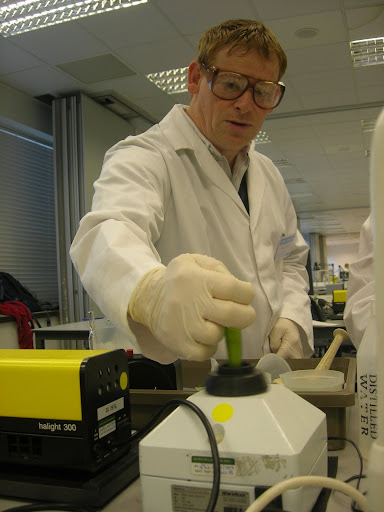
The morning brings experiments on single celled green algae (Chlamydomonas reinhardtii). We want to get some of them, shine light through them and see how much oxygen they make at different light intensities, including none at all.

Well its a bit of a disaster really, and we're trying to recover some data. First the water bath wasn't switched on, so we had to wait for that to come up to temperature. Then something went wrong with our calibration of the oxygen electrode, so we had to wash it all out and redo that, about 15 mins gone. We then eventually got results, but the electrode gave very spikey traces, and the results were not really what anyone was expecting, except in general terms.

So lunch, and then we'll try and get some useful data out of the noise (pasta of some sort)

After lunch things were no better - our graph looked like a roller coaster.
Everyone elses graphs were perfect.

Oh well - there is always the bar to drown our sorrows... oh after tea (something vaguely porcine) a tutorial or two...
Now done, and some sorrows drowned. Tomorrow is another day.

Sunday, 11 July 2010

SXR375 - Day 2

Day two. A patchy breakfast, fried egg or scrambled, sausage and tomatoes. I was reliably informed by others on the table that they doubted anything organic went into the scrambled egg, so my choice of fried seemed good. Still cereal and toast is ok, and coffee was welcome.

Off to the lab, and our first task was to grind up some leaves. We chose petunia leaves, other groups did tobacco, pak choi, coleus and others. We then extracted the pigments in acetone and diethyl ether. Then we did some thin layer chromatography, try to separate out the pigments such as chlorophylls, lutein, violaxanthin and neoxanthin. Some nice bands separated.
We then tried to take some of the bands - and analyse them in spectrophotometer. FIrst time it didn't work - we had the tube the wrong way round. Second time looked better, but one of the peaks was in the wrong place.

Then just time to put some flowers in to stew in HCl before a break for lunch.
After lunch, we came back and did similar procedures with the extract from flowers. We were looking for flavones and anthocyanins, using similar techniques. We had a hitch when we put our first TLC papers in the solvent, which turned out to have too much acid in, and they all dissolved into mush! Anyway - after coffee break we redid things, and they worked much better.
More chromatography, and some absorption spectra helped us isolate pigments from the various plants we'd looked at. We collated the data - wrote it all down and then went to tea (roast beef and yorkshire pudding).

After that I attended a tutorial on photosynthesis and plant pigments, and another on giving presentations.

Then - to the bar!

Saturday, 10 July 2010

SXR375 - Day 1

Its a hot day. with the help of the family I've got registered, found my room, and unpacked just a little.
The family were with me, and they helped me label by books and name tag.
The room has a fridge in it, a desk and a bed. A few other things like a kettle and so on.
Still - I won't be in it a lot. Lots of time in labs, tutorials, eating, or in the bar.

We had a walk around the campus to locate the biology building.

Then the family left, and I sorted out my things. The course started with an introductory talk which covered various administrative things, and then we went down to the labs. We were introduced to the courses tutors and formed up into small teams. I found two others who thought I would at least not cripple their efforts. We then had a look at the range of plants they had on offer, which tomorrow we will be extracting chlorophyll and other pigments from.
After that - back to the hall for lunch and a coffee to keep things going.

Next there is a guest lecture on pesticides, so I'm off to that.

This was good - with a good discussion of issues involved in feeding the world, GM crops, organic produce and so on. We then retired to the bar, where I started a table that grew to about 8-9 people discussing a variety of topics. It was a good evening - hope the alcohol intake doesn't disrupt tomorrows labs!

Next SXR275 Prev SXR375

Wednesday, 7 July 2010

SXR375: Plants and Pigments - CMA

There is a CMA that has to be done before attending the school. You have to score 35% or more on this, to stand a chance of passing the course. Sneakily, although you can see why, you don't get the results until after the residential school.

Its 20 questions, all multi choice. However some are "choose the correct answer", some are "select up to 3 true statements", some are "find the two false statements" and some require work to be done, graphs to be plotted to get the answer. A few of them are based on research papers which we have a copy of, that we have to dig the results out of.

All in all, its not too bad. I think some of the questions are a little ambiguous, but I think I'll pass OK. One question that insults my sense of logic is "Select three correct answers" and we have A-F to choose from... except F's answer is "All of A-E are true". So if you choose this, doesn't that invalidate choosing 3?

I have a slightly freaky moment, when on the last 4 questions, I realise I've been using last years question paper rather than this years! Ooops - good job I spotted that.

Anyway - its gone now! Time to pack now - and remember to take my new white (well it is currently) lab coat!

Next SXR375 Prev SXR375

S377: TMA-2

So TMA-2 of the course. Five questions.

The first one is about mitosis, and the anaphase part. You have to draw a diagram of a cell on the verge of splitting its chromosomes. Then talk about the proteins involved in the separation and the conditions required to bring about the separatation. Then a bit to answer on what happens if any of the mechanisms fail.


The next question is about DNA replication and how it happens, what speed it goes at and how it differs between eukaryotes and prokaryotes. Also a classic experiment on the process is investigated to explain how it works.

Question 3 is about transcription. It considers the TATA box, and how transcription factors are involved. Then the epigenetic DNA modifications and how they are preserved.

Question 4 you have to investigate a zinc finger transcription factor and look into the structure of it. How the metal ions are held, and how it interacts with the DNA molecule. Finally you have to show part of the model with some parts highlighted in colour and labelled.

Question 5 you have a paper about a membrane bound protein, and there are a whole load of questions on it. Some is stuff from the course, other is data from the paper. There are a lot of questions, and I found it easy to get out of step answering a little too much in a) and then not including some of the data in b) so losing marks.