Google
 
Showing posts with label experiment. Show all posts

Sunday, 7 February 2010

S366: The brachiopods measure up

So - with the arrival of the practical kit, and the appropriate part of the course reached. Its time to do some practical stuff. So here we are - presented with 30 plaster casts of various brachiopods, all from the same era.

My task is to measure them with the supplied calipers. They are accurate to about 0.1 mm although I suspect most of the error measurements comes from how you actually attempt the measurement. For each of the 30, I have to measure and record the length, width and thickness of them. Now you might think this is simple enough, and I suppose it is, until that is you offer up the first sample to the jaws of the vernier calipers. Width is perhaps the easiest, as there is really only one width, and the only trick is making sure the sample is perpendicular to the jaws to get a true reading. Length is next easiest, but you have to do it in the right orientation otherwise off axis sticky out bits tend to make it seem longer than it is. Thickness is more tricky, as the thickest bit on one side is not opposite the thickest bit on the other. Therefore you have to make sure the "seam" is appropriately flat to the jaws and you haven't got the whole thing crooked.

All simple enough really, but rather than sitting down at a table in a good light with sharpened pencil and pad, I find myself sliding into the event sitting on a settee with the TV on (Horizon) and dispensing with the pencil altogether and recording straight into excel. Is laziness ever a virtue I wonder? Its certainly much easier to read my writing back afterwards, so maybe it is. I'd planned the well lit desk I think, but just somehow drifted into the first measurement, oh well...

With the results recorded there is now a whole heap of stats to apply to the numbers to see if there is a correlation at all, if there is a relationship between the three dimensions, and then finally how they compare with some brachipods from a slightly different era. The calculations are not hard really - as either excel or a supplied program can do them, but they are fiddly. There are quite a number of them, and its quite easy to divide one number by the wrong one at some point which means the final answers are way out of line. It takes another night, and a fresh look at the calculations to have any confidence that the chain of about 20 results really do end up with something sensible. I mean, does -6.2 sound about right to you?


Next S366 Prev S366

Tuesday, 4 September 2007

S204: TMA-6 / Experimental Week 2

Back to the potatoes!

Oh yes - the potatoes have their revenge. In this combined experimental week and TMA you have to do a new experiment of your own devising on the poor potato homogenate and then write it up fully as TMA-6. This is very similar to TMA-2 except you have about twice the word limit, and you have to write much more about everything, but particularly on the biological mechanisms that you are investigating. On the plus side, this is all you have to do for this TMA!

After a few flights of fancy, I decided to follow the advice and stick to something reasonably simple. A couple of options were to vary the temperature or pH of the solution and see if there was any discernible difference in results. I figured that what they were looking for in this exercise was producing some results and analysing them. They were not looking for new contributions to science.

Its a lesson I've found rather hard to come to terms with in this and other courses. For instance the whole purpose of catalase in the potato homogenate is to break down H2O2. Now why would you have H2O2 present? It turns out this is how free radicals, those rather dangerous reactive molecules are flushed out of the system. They are converted into hydrogen peroxide to partially neutralise them. However should H2O2 come into contact with Fe ions, you suddenly have a worse problem than before as it will make very very reactive free radicals, as opposed to just reactive free radicals. If you follow this through, you find all sorts of interesting avenues, such as oxidative stress, mitochondrial errors, apoptosis signals and so on. Although some of this can go into the report, you have to curb your enthusiasm and write down only what the mark scheme is likely to be looking for. This does mean somewhat that you have to try and stick to the course materials as if you find new discoveries since they were written, or more advanced descriptions of mechanisms, no matter how right they are, they are unlikely to get you marks.

Anyway, I settle for two temperatures and attempt to see if there is a difference in reaction rate. This is actually more chemistry than biology, heat increases all reactions. The only biology that comes in is that most catalysts are rather fragile enzymes that will fall to bits if you heat them too much. So I pick two temperatures that are likely to work. A temperature of 0°C is easy to maintain with ice-cubes, a warmer temperature is more difficult. Without some sort of heating, it will tend to cool, so I pick a temperature about 10°C above room, and hope that a large enough water bath won't cool too quickly to affect things. I know catalase works in animals up to 37°C so I don't think potato catalase will fall apart at 28°C or so, so I should be OK.

It would be interesting to look at a whole range of temperatures and see where its peak rate was, and where it started to denature and so on. But ambition must be curbed, and if you've spent a few hours counting drips from mashed up potato juice, this is actually surprisingly easy to temper! Plus you can only do a t-test on two sets of results, so that's all you really need.

After about 4 hours or so, I've been through the experiments, which include a couple of pilot experiments to work out appropriate concentrations and drip rates.

The write up is much easier than the last TMA, although it takes a while to get it all formatted and the biological data into place, run the t-test software on the results and so on. Ultimately though, it is just a question of doing the time and formatting the results. None of the cold hand of fear from the last TMA! Some faith restored. I struggle to reach close to the 2000 word limit, and a certain amount of revision is required to get not too far away.

Saturday, 24 February 2007

S204: Experimental Week

Biology has a high amount of practical work to prove mechanisms and pathways, so there is an experimental strand to the S204 course. We are about to start on the first week of this, with investigative week one.

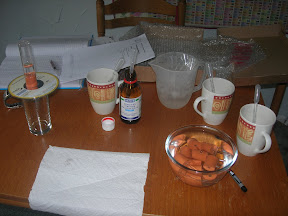
The task, should we decide to accept it - and the fact it will be examine in the mandatory TMA-2 is a good indication that one should, is to look in detail at the breakdown on hydrogen peroxide into water and oxygen. There is a enzyme catalyst for this reaction found in many living cells, as it is part of the chain that disposes of oxygen free radicals. In this case, we're going to get them from a simple source, the humble potato. The experiment also involves buying some H2O2 which causes some interest. This is one of the alleged substances that the terrorists were planning to use in their liquid bombs, so a raised eyebrow is not uncommon when asking for some at a chemists.

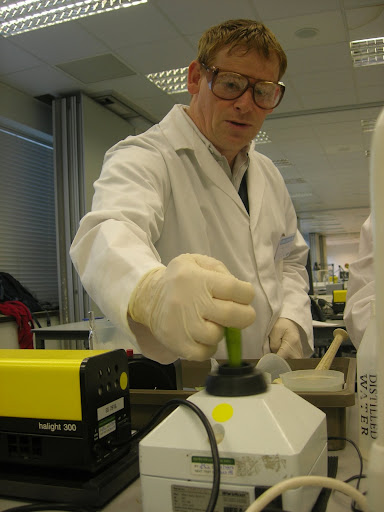
We have been sent an experimental kit, which consists mostly of test tubes with rubber bungs and glass pipes in them. Also supplied are pipettes and safety glasses. I elected to wear the glasses in the first part of the experiment as I'm sure it made me look more like a proper scientist.

The potato has to be liquidised to get at the enzyme, and then left to separate into a rather unappealing mess. Also the hydrogen peroxide, various containers of water and a stopwatch are required, as is a notebook to record all the results.

Experiment one is to try and find a mixture of this potato juice, water and hydrogen peroxide that reacts at a reasonable rate. Not so fast that it sprays all over the kitchen, and not so slow that it drips at an uncountable rate. It takes a bit of practice to assemble the components in a timely manner so that drips can be counted, that give an indication how fast the breakdown is occurring.

Experiment 2 is to repeat the experiment a number of times with the chosen mixture, and see at what time the peak production occurs.

Experiment 3 looks at varying the concentration, under the hypothesis that concentration does affect the rate of breakdown.

It is deadly boring counting the drips towards the end, especially on the control samples where nothing much happens. By the end of the set of experiments I'm a little less enamoured of potatoes and their extracts than I am at the start, but I have gathered some results at least, which will come in useful.