Its another day out with the open university. This time its a day of talks, tutorials and other stuff happening at the Leicester National Space Centre.
We arrived at about 10, for a 10:30 start. The first problem showed up as we got there. I had thought to myself the last thing I should do is forget the piece of paper with the itinerary on it - and sure enough - that was the last thing I did - forget it!
Oh well, CR recognised me when we got to the front of the queue, and they had updated timetables so that was no problem! We also got our tickets to the various lectures.
The first talk was by Professor Barry Jones, and covered some of the block 12 material about extraterrestrial life. He covered a bit about how life might have started and the necessary conditions. He then talked about the chances of life on Mars and Europa. He also talked a bit about exo-planets and the search for earth like ones. I tried to stop myself from thinking "that would have been a good point to include in my ECA". I asked him a couple of question after the talk, as did a few others.
Then we had an S103 tutorial titled "The real Alchemy" on atomic numbers and radioactivity given by Dr Anthony Headley. It showed the difference between nuclear and chemical reactions, and the alchemists dream of changing one element into another. It was followed by a breakout session where we worked through some examples in groups. Things like, what would 14C decay into and what happens to the atomic number and mass.
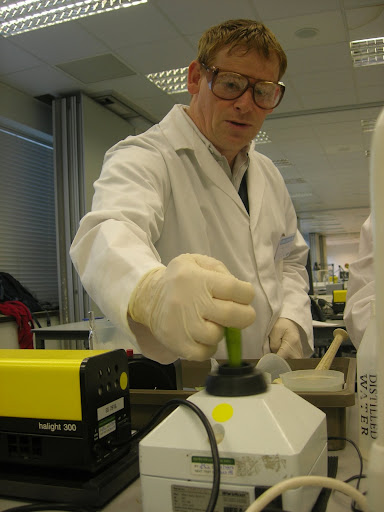
After a brief lunch, we went to another tutorial on organic chemistry by the same Dr Headley. This was followed by another breakout session where we worked with chemical model kits, making up polymers. Tutors were on hand to help out and check our answers - I think our table made the longest molecule of polythene.
Then another talk by Dr Emma Taylor on crater impact research. She has the use of a very big gun to blast things at other things to try and reproduce craters on moons and similar. She also did practice drops of ball bearings into Sainsburies flour, which is apparently a lot less expensive to set up than a week long test on the big guns!
Finally we went to a talk about rocks from space by Dr Victoria Pearson. This looked at all the types of meteorites that come from space, and how you find them. She had brought along a suitcase full of samples - including a very heavy iron one which we were all much impressed by. Also she had a tiny part of a Martian meteorite, a very tiny lunar meteorite and a slightly bigger earth meteorite (having been blasted off the earth, floated around a bit and then come back into the atmosphere). She also had some very thin sections of meteorites which we could look at through polarising microscopes - from these you could work out some of the mineral content.
The talk was given in a sort of open area in the space centre which was rather noisy and subject to interruptions over the tanoy. However it was extremely good, and we attended the last of three talks she had given that day.
The organisers were a little disappointed that not many S103 students had turned up. I talked to a few people present, and there were a lot of short course students it seemed to me (on a rather unscientific survey!) who were looking to see if S103 would be a course they could do.
I got to look at a few of the 2nd and 3rd level courses I was considering - which was also useful.
Showing posts with label S103. Show all posts
Showing posts with label S103. Show all posts
Monday, 2 July 2007


Friday, 1 June 2007
S103: Block 12 and the ECA
Block 12 is a little different to the rest. A number of people spent a while digging through their S103 collections (or in my case ill assorted piling system) looking for the block 12 book. Well there isn't one. What there is, is a collection of papers and articles about the origin of life and life on other planets. These all relate to the ECA (End of Course Assessment).
So you have to read the study guide, read the relevant papers that are associated with the ECA topic, and choose what are required.
The ECA is a bit like a bigger TMA, though not much bigger than a regular one. It does however have quite a lot riding on it. If you fail the ECA you fail the course.
Question 1 is reasonably straight forward. You are given some data on endangered species and you have to do a bit of maths with it. Work out averages, percentages that sort of thing. Also a histogram plot is required. 10 marks
Question 2 looks like geosciences, its about lava flow rates and things like that. You are given a graph of a lava flow plotted against time for a volcano. However really it is all physics. You have to calculate average speed, make predictions and calculate the mass of lava based on specific heat capacity, which requires some equation rearrangement. 21 Marks here
Question 3 is chemistry, and maths. You have to calculate a relative atomic mass based on a formula. Also balance a chemical equation, and finally rearrange a couple of algebraic equations. 10 marks
Question 4 some more data about rainfall and drainage. It has to be plotted as a graph and a best fit straight line found. The graph is used to work out a bit of information. Then you have to hypothesis about what happened to the missing water. 9 marks.
Question 5 is part II of the ECA and you have to write 1000 words on "What conditions would be required on an Earth-like extrasolar planet for carbon based life to evolve". You have to include in the account:
I found this essay quite hard to write. I have read up a lot about the origins of life over the last few years, so I knew a lot about the subject. However I needed to limit myself to the data available rather than go off in raptures about competing theories. Still - eventually it was all wrapped up and printed out, with the graphs drawn. They require 3 copies of this work as it is shipped around to various places to be marked and validated.
With the ECA finished, posted and an indication on my OU home page to say it had been safely received the 9 month epic had come to an end. There was a rather sad feeling on the conference as people said their electronic goodbyes, and we all wished each other well, and maybe see each other on future courses.
So you have to read the study guide, read the relevant papers that are associated with the ECA topic, and choose what are required.
The ECA is a bit like a bigger TMA, though not much bigger than a regular one. It does however have quite a lot riding on it. If you fail the ECA you fail the course.
Question 1 is reasonably straight forward. You are given some data on endangered species and you have to do a bit of maths with it. Work out averages, percentages that sort of thing. Also a histogram plot is required. 10 marks
Question 2 looks like geosciences, its about lava flow rates and things like that. You are given a graph of a lava flow plotted against time for a volcano. However really it is all physics. You have to calculate average speed, make predictions and calculate the mass of lava based on specific heat capacity, which requires some equation rearrangement. 21 Marks here
Question 3 is chemistry, and maths. You have to calculate a relative atomic mass based on a formula. Also balance a chemical equation, and finally rearrange a couple of algebraic equations. 10 marks
Question 4 some more data about rainfall and drainage. It has to be plotted as a graph and a best fit straight line found. The graph is used to work out a bit of information. Then you have to hypothesis about what happened to the missing water. 9 marks.
Question 5 is part II of the ECA and you have to write 1000 words on "What conditions would be required on an Earth-like extrasolar planet for carbon based life to evolve". You have to include in the account:
- How the occultation technique can indicate the presence of a large extrasolar planet
- Summarize the key chemical and physical factors required for the development of life on an Earth-like extrasolar planet
- Discuss the stages of chemical evolution that would need to occur towards the development of life, giving the timescales that were thought to have occurred on Earth
- Discuss how comets might have a role to play in life evolving on an Earthlike extrasolar planet in a distant solar system.
I found this essay quite hard to write. I have read up a lot about the origins of life over the last few years, so I knew a lot about the subject. However I needed to limit myself to the data available rather than go off in raptures about competing theories. Still - eventually it was all wrapped up and printed out, with the graphs drawn. They require 3 copies of this work as it is shipped around to various places to be marked and validated.
With the ECA finished, posted and an indication on my OU home page to say it had been safely received the 9 month epic had come to an end. There was a rather sad feeling on the conference as people said their electronic goodbyes, and we all wished each other well, and maybe see each other on future courses.
Tuesday, 1 May 2007
S103: Block 11 - Universal Processes
I must admit I didn't spend too long on this block. I'd done all the required TMAs, so this block was only for interest, to see what had changed in physics.
Its quite interesting though, it goes through a lot of cool physics, like discussing the 4 forces, how the universe came about and other cosmic theories.
In the TMA which I didn't do, there are the following questions
Question 1 relates to an experiment that you had to do as part of chapter 7, in which you have to write it up formally, and do some question associated with it. They are all related to determining energy levels of atoms.
Question 2 gets you to calculate forces between elementary particles and draw diagrams of interactions between certain collisions.
Question 3 is about the Hubble expansion law, and red/blue shifting of galaxies.
Question 4 looks at black body radiation and ends with a sub question on the open/closed universe question.
Wednesday, 18 April 2007
S103: Block 10 - Earth and life through time, TMA-8
Block 10 - nearly at the end now. Its back to rocks and fossils this time.
There is a fair bit of detail in this block, covering how rocks are laid down, how they can change over time and so on. This is also where you get to look at the fossils that came with the experimental kit several months ago.
There are sections on fossilisation and the early history of life, a chapter all about crystalline minerals and how to recognise them. Then some words about igneous rocks and how they can occur in different formats and structures. Then consideration of sedimentary rocks and the important distinctions that show their history (a good DVD program about this). Then finally metamorphic rocks, and what they're all about.
Then some words on geologic time, and some details of the UKs geology. There are some DVD exercises to do, most of which I get wrong!
However - I elected to do this TMA, so its time to get started.
The first question you have to fill in a table of descriptions that is partially filled in. There is an igneous, metamorphic and sedimentary example. This question is a bit confused by them printing some of the captions wrong. Also I assumed they wanted similar amounts of detail to their sample text, but it turned out they wanted a fair bit more. You also had to draw a sample of how a particular layering would look, and describe the consequent history of the region
The second question is about describing how felsic rocks can be made by fractional crystallisation from more mafic rocks. Apparently they wanted a number of examples for this question, which I didn't include!
The second half got you to explain how uranium/lead dating is done.
The third question is an essay og 800 words on "How interactions between the Earth systems affect the climate". That isn't too bad, although it IS an essay, and I did reasonably well on it.
However from all the points drop in the first questions, and the fact that its difficult to get close to full marks on any essay, its my worst TMA of the whole course. Oh well, thats it for me and TMAs - I only have the End of Course Assessment (ECA) to do now.
Sunday, 1 April 2007
S103: Block 9 - Continuity and Change, TMA-7
Onwards to block 9 - and its more biology.
The fact that block 8 is encouraged to be read kicks in straight away. There is a fair bit of biochemistry in the early chapters as they discuss biological polymers like proteins, nucleic acids and lipids.
Then it is off into the rather complex TCA cycle, also known as the Krebs cycle, or vitamin-C cycle. This is how nearly all living things make energy. It covers this material in reasonable depth, and has a very nice animation and explanation in an accompanying computer program.
This gets a little confusing for me, because at a similar time studying S204 it also starts to cover the same material and in even more detail.
After that, its into the other end of energy mechanisms, where the photosynthetic reactions are covered.
Then, the next collection of chapters is all about DNA and genetics, and then leads into evolution and a bit about speciation.
Now the TMA on this block.
The first question is a nice easy one. Its just a paragraph about Lynn Margulis and her theory of the symbiotic relationship between mitochondria and the eukaryotic cell. You have to fill in the blanks from the given words. Its a nice and easy 8 marks.
Question 2 is about lactose, and starts off by getting you to show how the molecule is built up from glucose and galactose. Then it considers the effects of lactose (in)tolerance and how it might have come about by an evolutionary path. It also involves a genetic mating diagram, a bit of DNA decoding and a short essay. There are 7 sub-parts to the question, with 31 marks available here.
Question 3 looks at two genes and considers linkage between them. You have to draw diagrams of the chromosomes and how they might possibly split when meiosis occurs. 14 marks.
Question 4 and there are 7 marks for explaining the term regulating mortality factor as it applies to holly leaf miners.
Question 5 - they saved the biggy for last. 40 marks for a 700-800 word essay on the subject of "The metabolism of green plant cells in relation to energy exchange processes". Wow - this is a big subject. You have to cover both respiration and photosynthesis and the energy exchanges that are undertaken - all in 700-800 words. I draw a rather fine diagram in word covering the whole glucose oxidation and electron transport chain, and then rereading the question find that all diagrams must be hand drawn. After spending over an hour tweaking this diagram I am more than a little miffed I didn't notice these instructions earlier. I contacted my tutor to see if there was any way to salvage this. It seems silly to print it out and then trace over it or similar. I can't see why they insist on it being hand drawn either. I was in two minds, just delete the whole thing or include it and hope I only loose 1 mark, but gain a couple for the detail.
In the end I kept the diagram in, as my tutor didn't seem too concerned about it. However my planned diagram on photosynthesis never sees the light of day!
I lost a mark or two on this essay for not including any chemical equations - but otherwise I get a pretty good mark for it.
Sunday, 11 March 2007
S103: Block 8 - Building with atoms, TMA-6
Block 8 - and its wall to wall chemistry.
After the horrors of Block 7 several people found this a bit easier, and some didn't. There are apparently two points in this course when people give up. The first is when they receive the first lot of course material and realise what they have let themselves in for.
The second is about this point when the first of the optional TMA's is presented. The course has been picking up momentum to this point, and I guess its a make or break point. If you had been struggling up to this point, this is probably the straw that breaks the donkeys back.
Anyway, the course covers
Electron orbital theory, then into chemical bonding types.
A chapter on chemical reactions and energy changes, and then a look at taht werid molecule water. This is followed up by discussing chemical equilibrium, and a bit about acids and bases, then its back to rates of chemical reactions, with a brief detour into industrial reactions.
Finally a forrey into organic chemistry, and a look at functional groups and their reactions, rounded of by chapters on polymers and pharmaceuticals.
I found it all very interesting and it left me with more questions than answers in some ways, as only the basics were covered - so I was always left wondering "Yes, but why..."
For the TMA the first question came from block 7. However I found it very easy compared to the depth of material in there. I think I could have answered most of it without reading block 7. There was a bit about energy absorption and emission spectrum's, transmutation of elements and a little bit on half-lifes.
Question 2 was chemical bonding, and drawing structural and lewis formats for bonding.
Question 3 was about pH of acids, and involved calculating the pH of a given solution.
Question 4 got you to explain an industrial reaction with relation to Le Chatelier’s principle, and talk a little about catalysts. This was a descriptive piece mostly.
Question 5 was about polymers, and you had to draw some polymers and report the type of polymerisation being done. Functional groups also had to be labelled.
I didn't find this TMA too difficult, although my dislike of essays didn't help with question 4.
Friday, 9 February 2007
S103: Block 7 - the quantum world
Now its into block 7, and we're exploring the quantum world.
This is a touch subject, not particularly because its hard, but because it is non-intuitive.
As Niels Bohr said,
A number of students sink to their lowest ebb at this point in the course it seems. Quite a few find this very difficult material, and as it is so other worldly, they struggle through.
However, for this course, its not all bad news, as only half of this book is assessed in the next TMA, and that TMA is optional. There are 4 more TMAs to do at this point in the course, which are basically:
This is a touch subject, not particularly because its hard, but because it is non-intuitive.
As Niels Bohr said,
Those who are not shocked when they first come across quantum mechanics cannot possibly have understood it.And as Richard Feynman said
I think it is safe to say that no one understands quantum mechanics.The first few chapters are about quantum indeterminacy and the problems with uncertainty at the quantum level. Then we explore the various fundamental particles and the wave/particle duality of light.
A number of students sink to their lowest ebb at this point in the course it seems. Quite a few find this very difficult material, and as it is so other worldly, they struggle through.
However, for this course, its not all bad news, as only half of this book is assessed in the next TMA, and that TMA is optional. There are 4 more TMAs to do at this point in the course, which are basically:
- TMA-6 - a little bit of quantum physics, but mostly Block 8 chemistry.
- TMA-7 - Biology
- TMA-8 - Geosciences
- TMA-9 - Physics
Sunday, 21 January 2007
S103: Block 6 - Our world and its atoms, TMA-5
Block 6, and its firmly into chemistry, with a small detour into physics at the end.
In this block we start looking in much more detail about atoms and elements. There is a fair bit of history of the way things were discovered, how to balance chemical equations, molecular weights and stuff like that. I knew quite a lot of this already, but some of the details were quite fascinating.
How they worked out chemical formulas for compounds for instance, and molecular weights. There are also some nice videos showing chemical reactions. Everyone loves the alkali metals interaction with water - especially my children!
The TMA is solely about this block this time.
First question is all about hydrogen selenide, a compound not covered in the block. Using the rules and knowledge gained from the block though you can work out all the details. You also have to draw a set of chemical apparatus to produce a sample of the gas.
The next question is about chemical calculations on arsenic and some of its compounds. Molar calculations come into the fray here.
The final question is about the element Uuh - one that hasn't quite been discovered properly yet, though there is a placeholder for it in the periodic table. We have to extrapolate from knowledge of other elements what it would probably be like.
This is my best TMA in the whole course, and I scored 99 out of a possible 100 for it.
Its quite interesting how the whole marking thing goes. When you get to close to the maximum, its almost down to luck how you score. It is incredibly easy to miss off a unit, forget the right number of significant figures or something somewhere in the 4-5 pages of answer. I lost a mark in this one for not labelling a connecting tube in one of my drawings of chemical apparatus.
Friday, 12 January 2007
S103: A slight hiccup
I had managed to complete TMA-4 just before Christmas which was well ahead of the early January deadline. I had an ulterior motive for this, and it wasn't just so that I could enjoy the festive season. I had wanted to see how well I got on with S103 and if I wasn't finding it too taxing, then I might be able to start a new course in the new year. So I was working on getting up a good head of steam so I could make some time for a 2nd level course, the biology one - S204.
So - I had handed in my TMA before Christmas, and started work on block 6, which was chemistry. However after Christmas, we had a slight break in proceedings. I turned up at the first tutorial of the new year, and the building it took place in was even more disorganised than before. They had a lot of building work going on fitting out new classrooms and things, and this time it was even darker and more eerie than the first tutorial. It appeared they were improving security and were going into a keycard system of access.
I checked at the reception and a security guard showed me to the tutorial room, which was in a slightly different place to some of the previous ones. Instead of an organised room with a circle of tables laid out as normal, with a smiling tutor, the room was dark, and empty. The guard switched on the lights and left, and I sat down and unpacked a few things. Another tutee turned up shortly, and we arranged the desks into our customary circle and chatted about things.
After about 30-40 minutes, we decided there must be a problem, and either we were in the wrong place, or maybe there was a tutorial going on elsewhere. Anyhow it looked like there wasn't going to be much happening tonight. We packed our things up, and put the tables back, and then made our way out.
Then, we found a problem. We managed to find our way back nearly to the entrance, before coming up against one of those keycard doors. We couldn't open it. We looked around for a button to open it, but there didn't seem to be one. We then tried to find another way out, and found a few other rooms and various places. Eventually we found an outside fire exit door, which said it was alarmed. However we decided after a bit of discussion to try this. We pressed the release button, and nothing happened. We tried a few other things, but it wasn't going to open.
So, we turned back and made our way to as near as reception as we could get, and tried banging on the door, but in vain. Finally my colleague had a mobile phone, so she phoned directory enquiries, and after a few attempts managed to get them to put us through to the college, and got through to reception where she asked them to come and let us out!
The next day I tried to contact my tutor to see if we'd got the wrong place or the wrong day or something, but I didn't get a reply. So later in the week I contacted the regional center, who moved swiftly to sort things out. It seems my tutor had been taken into hospital and with Christmas and the new year things had got a little confused.
Anyway, the centre found us a new substitute tutor, and arranged for our TMAs to picked up and marked by alternate tutors, and everything was soon back on track.
Monday, 18 December 2006
S103: Block 5 - Energy
Block 5 - and the subject and title is Energy.
Its all the stuff you might expect. What is energy, what is power, work. What units do they use, and how do you calculate it.
It covers most basic forms of energy such as the Sun, gravitational potential energy, and stuff like the latent heat of vaporisation.
There are quite a few equations in this book, but the good news is its only 67 pages long! I managed to do most of this book while lying in bed with a thick cold. I know a number of people found this book a little harder than the rest of the course so far. Its perhaps the maths and the scary looking equations, although really they are not that bad.
The course is often described as starting nice and easily, and then the content starts to ramp up, and this is perhaps the first indication things are getting quicker and deeper.
The associated TMA, TMA-4 is split between block 4 and this block. There are 3 questions on block 4.
A question about k and r species.
Another question about food webs, net productivity and so on where you have to calculate biomass increases.
Then a 250 word paragraph about species on the Galapagos islands.
Then a question on specific heat capacities with a few calculations.
Finally a question about kinetic and gravitational energy.
Saturday, 9 December 2006
S103: Block 4 - Unit within Diversity
Block 4 and its time to get into some biology.
Book 4 is called Unit within Diversity and covers a fair bit of biology in not much depth, but goes into a fair depth in the ecology and evolutionary aspects.
It starts out discussing what is life, and some of the historic moments in the science of biology. There is a brief chapter about cells and genetic material, then its into the main topic which is the diversity of life.
There is quite a lot of DVD work in this book, several hours in total, where you get to explore the Galapagos islands and make inferences about adaption and speciation. The dvd ahs a lot of question and answers coupled with film clips from various experts discussing the finch population and the marine iguanas. I can still here the learned doctor on the DVD saying "Correct" and "No" even after the course has finished, he has quite a distinctive style.
There is also a big section on ecology, building up food chains, and looking at the energy used in a food web, what depends on what etc. We get to find out how many oak trees are required to raise one bird of prey, through caterpillar and blue tit intermediaries.
There is no TMA specifically about this block, but the next block will be included. So its onwards and upwards.
Friday, 3 November 2006
S103: The second mailing arrives
The second mailing arrives - which is always an exciting time! A big cardboard box with a load more books, the experimental kit and some notes and stuff.
As mentioned in the previous article, I'd had to wait for this mailing before I could continue as the rock kit is required for one of the exercises in block 3.
One nice thing in this block is how thin some of the books are. Book 5 for instance is so thin it doesn't even have the title printed on the spine. There is a certain amount of relief with this discovery. However after experience with the blocks, you find that sometimes the shortest blocks have the longest experiments or DVD exercises.
This mailing takes us all the way up to block 8, and with it arrives the question for TMA-4, 5 and 6. Its best not to look at these to early as they often look impossible before you start the blocks.
Anyway, no excuse now, onwards
S103: Block 3 - The Earth and its place in the Universe, TMA-3
Block 3 is a bit of a strange block in this course. Its called "The Earth and its place in the Universe" The overall theme of the whole course is "Taking the world apart and then putting it back together". I'm not too sure how much the theme helps, and how much it constrains some of the topics.
Anyway, block 3 starts with some astronomy, and where we are in the universe. Then it moves onto newtons laws of motion, which are I suppose vaguely related. It then goes into volcanoes, plate tectonics and the rock cycle. You kind of get the feeling a number of bases had to be covered and two or three books have been condensed and glued together. The text is fine and very readable, and no jumps so its not a cut and paste job, but the swift change of subjects does feel a little odd for one book.
Book 3 also introduces the practical kit which arrives at about this time, although I had to wait a while as I was a couple of weeks ahead of schedule at this point. It has a collection of rock samples, a set of fossils and some other bits and pieces to be used in experiments later. One of the exercises is to identify the rocks with help of the notes. This is very similar to one of the lab sessions in SXR103.
The TMA for this one is not too bad.
The first question involves working out orbital periods, and involves drawing another graph. Its basically getting you derive Keplers laws. There were a few who stumbled on this one based on some of the forum comments. Its one thing to draw a graph, its another skill to use a graph to work out a value, or even to realise you can use a graph in this way.
The next question is about earthquakes, and you have to draw a cross section of the crust and fill in lots of details. Its not too bad but took be about 5 goes to get an appropriate scale to fill the page. I also resorted to colour to show the different structures.
Finally the 3rd question looks at magnetic survey data and gets you to work out the plate drift rate.
Wednesday, 1 November 2006
S103: Block 2 - A termperate Earth?, TMA-2
Its on to block 2 - which is mostly about temperatures and climates and some of the science behind it. It looks a lot at global warming and the evidence, but doesn't go into too much detail - they are still breaking you in at this point, teaching you about notation, how to do powers of 10 and so on.
TMA-2 is all about temperatures. In question one you have to calculate some 7-year mean averages, add some extra points to a printed graph and do some explaining.
Question 2 requires plotting a histogram of some data given about temperatures. Then from this data you have to work out what sort of rainfall would be expected in a given month, and then convert the answer into SI units.
Question 3 and its a small essay on the effects of global warming on flooding in 300 words (max of 350) - it gives you quite a lot of help specifying what should and shouldn't be included, and a diagram is required. You have to draw such diagrams by hand, which I've argued with the powers that be at the university a couple of times. I don't like doing them - partly cos I'm a rubbish drawer, but mostly because it means my report is scattered around. Most of it is word processed, and then I have to leave a gap and fill it in later. I usually return to the TMA-s a few times before posting them, and tweak them or correct a spelling - which then means redrawing the diagram again. BAH! Well rules are rules...
Question 4 is about greenhouse gases, you have to explain why greenhouses gases work, and you have to draw a molecule.
Finally - you are asked to explain how you prepared the report and if you think your technique will work for bigger reports. I posted two versions of this - see if you can work out which is the real one!
Answer A
Answer B
TMA-2 is all about temperatures. In question one you have to calculate some 7-year mean averages, add some extra points to a printed graph and do some explaining.
Question 2 requires plotting a histogram of some data given about temperatures. Then from this data you have to work out what sort of rainfall would be expected in a given month, and then convert the answer into SI units.
Question 3 and its a small essay on the effects of global warming on flooding in 300 words (max of 350) - it gives you quite a lot of help specifying what should and shouldn't be included, and a diagram is required. You have to draw such diagrams by hand, which I've argued with the powers that be at the university a couple of times. I don't like doing them - partly cos I'm a rubbish drawer, but mostly because it means my report is scattered around. Most of it is word processed, and then I have to leave a gap and fill it in later. I usually return to the TMA-s a few times before posting them, and tweak them or correct a spelling - which then means redrawing the diagram again. BAH! Well rules are rules...
Question 4 is about greenhouse gases, you have to explain why greenhouses gases work, and you have to draw a molecule.
Finally - you are asked to explain how you prepared the report and if you think your technique will work for bigger reports. I posted two versions of this - see if you can work out which is the real one!
Answer A
I constructed the answer to question 3 by first writing down the information I remembered from the text in brief sentences. I then added the diagram, and went back to the text to fill out the explanation in more detail. After that I re-read the explanation and reformatted and changed some sentences around so the piece read more logically and in a better order.
I need to read the questions more carefully, but I think this approach works for me and will scale up to larger works.
Answer B
I wrote up a description of the water cycle and how it affects flooding together with some speculation about the effects, the likely impacts and the long-term outlook. I then re-edited it a bit with some additional text, and found I was up against the word limit.
I did some editing and collapsed a few sentences, got quite a succinct answer but there was a lot of detail to get in, and I was still quite close to the maximum 350 words (like within 5).
I then discovered, completely by accident that there was a part b) to this question, and that my answer to part a) had answered most of part b) too. This, by deduction helped me work out what should and shouldn't be in part a) a little more clearly. So I reread part a) more carefully, and then ended up deleting about 2/3 of the original answer as it was now no longer relevant.
I was now well under the word limit, so thought I ought to expand on the answer a bit, and filled it out a bit. It read much better now. Another re-read of the question and I found I'd missed out at least one of the asked for descriptions still, so I went and added that in at the relevant point.
The answer was now approaching the 350 words again by now, so I went back and trimmed the fat, collapsed a few sentences, deleted some bits that seemed extraneous. I went and re-read the question one more time, and this time I thought I'd got it all down pretty much. I was just over the 300 words but under the 350 max. I think I had all the bits that I wanted in, but I felt it was lacking a concluding sentence. So I added one of those in and then looked around to remove some text to make up for that. I decided one of my points could actually be part of the conclusion so moved that around and chopped it around.
Then I decided the first sentence was a bit pants, so rewrote that 3 or 4 times, and then decided it probably wasn't adding much to the whole thing, and deleted it, and squeeze a minor point it made in else where.
Another count and I was around the 310 level, surely there must be 10 words I could delete somewhere. I found a few spurious adjectives that could go, but then some of the sentences sounded a little bit funny, so I rewrote them slightly. I moved a couple of them around, and changed the punctuation a bit. I wasn't convinced it read that much better... but at least now I was at, lets see... 310 words! What the...? By now I'd spent well over an hour on a measly 300 words of description, and I wasn't even in the running for a booker prize!
Frustrated it had taken so long, I decided it was time for bed, and saved the document. Stumped off to the stairs, and then thought better and went back and saved the document to my pen drive, thinking I would be more than a little peeved if I lost the document at this stage.Later, I got my wife to read it, she made some good comments, and I changed a few of the sentences around, and ended up with almost exactly 300 words.
Friday, 20 October 2006
S103: First Tutorial
Its the first tutorial date, and I, after a little time with multimap, google maps, microsoft live, and an A-Z, am fairly sure I can find my way across the city to the secret location.
I've got a full tank of gas, a battered A-Z, its dark, but I'm not wearing sun glasses - hit it!
I roar off down the road, the radio is blasting out "Quote/Unquote" - anarchy has nothing on me, and the adventure has begun.
15 or 20 minutes later, and I've found the entrance to the school. Further more, I've found the car park, and wonder of wonder, a lit entrance with signs of life. Things are looking up!
I enter the building and approach the person on reception. I see a big sign saying something like DD123 tutorials in room 17. This looks encouraging. I say I'm here for the S103 tutorial.
"Oh yes" says the man, "That'll be room 101 - through the double doors and straight on".
"Thanks!"
Hmmm - room 101 has an ominous ring about it, positively Orwellian, not to say Merton-esque...
Through the double doors and past a lot of other doors - none of them with numbers on them. The lighting is not the best, and if this were a film, something bad would be about to happen, with the music rising to a creepy crescendo about now. I've come to the end of the passage, and it turns left - maybe I've missed a room or something...
WAIT - I'm sure someone following me! I consider my options, what would Jackie Chan do?
It turns out to be a fellow student and he's on the same search, so we pool our resources. The corridor makes another sharp turn, have we come too far? I see a number 47 finally - there is hope. We find a room 54, and a few others, but nothing approaching the 100s.
We are just wondering whether to make bivouac here for the night, when someone emerges from a nearby room, and lets us know that this is the S103 room - number 44. Ah, Ok.... Whatever...
I sit down and unpack a few notes and folders. There are 4 of us and the tutor, and we do a bit of idle chatter while waiting to see if anyone else finds us (unlikely I think!). Its at this point that the most useful bit of information of the entire tutorial is reveal. The purpose of that funny black plastic bit in the front of the study file.
You can insert the back cover of the current block book into it and it keeps everything together. I'm deeply impressed, and am still playing with it to this day. What WILL they think of next!
Our tutor decides to make a formal start, and introduces herself, and we begin the introductions. Then the door opens, and a security man shows in another 6 people, presumably lost souls who had been stalking the corridors like we had. We start again. What our background is, what we are looking forward to, and what we're not looking forward to.
In approximate order, the general trend for the not looking forward to subjects are Maths, Writing English, and Time management. No real surprises there.
One more person joins a few minutes later, having probably been directed to the basement somewhere.
Our tutor tells us a bit about herself, her role, what we can expect, some of the rules for TMA's and so on.
Some of us have had our materials for a while, others are still unwrapping theirs, and some are still awaiting arrival.
We have a brief break, but all refreshment machines have been switched off apparently, and on investigation the toilets are locked! A brave party decides to venture back to reception hoping to find an unlocked toilet, we never hear from them again... until the start of the next half.
The second half of the tutorial we do an exercise. We have a packet of liquorice allsorts, and we have to come up with a classification scheme.
After some discussion we decide to avoid the more obvious eaten and non-eaten category.
We categorise on shape, size and colour. Then we eat them.
A few more questions and answers and then its the end, we huddle together for support down the dark corridors but succeed in finding the exit without too much problem. I make my way home, picking the wrong road twice, but hey:
I survived tutorial 1 - Mission Acomplished!
S103: First TMA
OK - so its time to see if I can cut the mustard.
TMA (Tutor marked assignment) number 1. Basically its a bunch of questions to answer on the course so far to show your understanding of what you've read and done.
There are various complex rules about TMAs. Apart from the obvious, that they must be your own work, and without plagarism. To pass the course you have to score above an average of 40% on all TMAs. However you can substitute a bad TMA's by an averaged mark, so one bad one won't drag you too far down. Some TMA's are not substitutable though, so it all gets a bit complicated.
However if you do reasonably well on all the TMA's you'll pass. You also have to pass the ECA (End of Course Assessment) too - but that's another tale.
TMA-1 is different though - it doesn't count. You have to submit it in the usual way, but it doesn't matter what score you get - in fact you don't get a score, just comments. Your tutor marks it and tells you where you did well, and what you didn't get right. Thus when you do TMA-2 which does count, you'll know what's expected at least.
You quickly learn there are certain things they are keen on you getting right.
Units is one - you should use SI units wherever possible.
Another is significant figures. You are given rules of thumb for working out significant figures and how many places to give your answer to. So 3 x 1.2 should be given as 4 for instance, rather than 3.6.
Question 1 gets you to do various simple calculations involving percentages, density and so on. Mostly its looking at simple arithmetic and sig figs and units.
Question 2 gets you to look at a graph of a ball dropping and describe in words what its telling you.
Question 3 is to write a paragraph of 120 words about sweating in humans.
Question 4 is reflective, asking you to describe your study techniques and what you might improve.
I get a fairly good report on this TMA. It mentions I should use units throughout calculations more, and to consider keeping an extra significant figure until the end of the calculation to stop rounding errors.
Saturday, 30 September 2006
S103: Potatoes have feelings too.
Your mission, should you decide to accept it, find out the water content by percentage weight of your average potato. This is a block one experiment.
Now - what equipment do we need.
Now - slice up the potato, and already my helpers attention had started to wander. I wanted to slice them thin for speed, but decided I just needed to get on with it while the attention was focused on him trying to switch on the calculator.
Right - so into the nuke and blast for the first 4 mins. Out it comes, and its a little warm. We measure the weight, and I write down my first figures. I return the potatoes to the oven, while my helper tries to weigh his hand.
After a little bit of dissuasion, he's back on the calculator, now having got it switched on. So I ask him to type in the numbers whilst doing the arithmetic in my head as a double check. We have a few false starts...
By now the next 4 mins is up, so I do another weighing. I hear the calculator clatter to the floor.
Anyway, another weight recorded, and back to the oven. I turn around, and there he is is, trying to weigh his head this time, and read the numbers at the same time.
We do some more calculator work, and then he wants to know why crocodiles and caimans don't both live in the amazon.
The microwave peeps, and the calculator clatters to the floor. Another measurement, and my helper is getting quite good at subtraction. I manage to persuade him that weighing other parts of his body is really not worth it.
The next record and the calculations are definitely wrong, where we'd been subtracting 55g, he now wants to see just how many 5's he can get on the display. I think I've just found a new source of errors...
We're down to two minutes between bursts now, and there is barely time to drop the calculator and recover it between the measurements, but he rises to the challenge majestically.
The potatoes are now looking distinctly crisp shaped, and are very hot when trying to separate them.
Another couple of blasts, and there is no change in measurement, so I pronounce it done. The calculator clatters to the floor one last time in celebration.
I reflect upon the geniuses whose shoulders I am standing on, Newton, Galileo, Darwin, Einstein. I wonder if they'd have seen further with a little helper?
Preparation
After some time spent reading through the book, it was interesting to have a break and start some practical skills. Lets see, by heating the potato in the microwave, we can drive off all the water held in its cells, and see how much of it there is.Now - what equipment do we need.
- A microwave - check!
- A potato or two - check (Maris Piper, unpeeled, 3).
- A calculator - check
- Scales - check (digital ones, weighing in 5g increments - wooooh!)
- Notebook - check
- 5 year old helper - hmm, not mentioned in the notes.
Method
First job, find a suitable plate. I decide I want a lightweight one so that it won't affect the scales too much. If the plate weighed 10 kg, the scales probably wouldn't be very sensitive to a few grams change in weight.Now - slice up the potato, and already my helpers attention had started to wander. I wanted to slice them thin for speed, but decided I just needed to get on with it while the attention was focused on him trying to switch on the calculator.
Right - so into the nuke and blast for the first 4 mins. Out it comes, and its a little warm. We measure the weight, and I write down my first figures. I return the potatoes to the oven, while my helper tries to weigh his hand.
After a little bit of dissuasion, he's back on the calculator, now having got it switched on. So I ask him to type in the numbers whilst doing the arithmetic in my head as a double check. We have a few false starts...
By now the next 4 mins is up, so I do another weighing. I hear the calculator clatter to the floor.
Anyway, another weight recorded, and back to the oven. I turn around, and there he is is, trying to weigh his head this time, and read the numbers at the same time.
We do some more calculator work, and then he wants to know why crocodiles and caimans don't both live in the amazon.
The microwave peeps, and the calculator clatters to the floor. Another measurement, and my helper is getting quite good at subtraction. I manage to persuade him that weighing other parts of his body is really not worth it.
The next record and the calculations are definitely wrong, where we'd been subtracting 55g, he now wants to see just how many 5's he can get on the display. I think I've just found a new source of errors...
We're down to two minutes between bursts now, and there is barely time to drop the calculator and recover it between the measurements, but he rises to the challenge majestically.
The potatoes are now looking distinctly crisp shaped, and are very hot when trying to separate them.
Another couple of blasts, and there is no change in measurement, so I pronounce it done. The calculator clatters to the floor one last time in celebration.
Results
A bit of calculation, and I come up with a figure of very slightly over 80% for the water content.I reflect upon the geniuses whose shoulders I am standing on, Newton, Galileo, Darwin, Einstein. I wonder if they'd have seen further with a little helper?
Friday, 29 September 2006
Starting S103
So september comes around, and with it a large pack of books, papers, CD's and DVDs. Included was
I unpacked the contents on the kitchen table and tried to make sense of them. There was a lot of stuff there, and it was difficult to untangle it at first. They only send part of the course at this time, as they don't want to swamp you with information and make you run and hide.
However even with this reduced load I found it difficult to make sense of what to read first, second and so on.
They usually have a set of things, so you get a course guide - which is a one page synopsis of the chapters, and estimate of how long each part will take and what other media might be used. Then there is the course notes which have longer exercises to do for each topic. There is the course book too - which is where the main learning comes from. I usually forgot about the other two documents until prompted in the book to read various bits.
I tried going through the things in various ways, but in the end I couldn't really see which was the way to read these things. I gave up and just started reading book 1, The Water of Life which seemed to work out ok. Having done science before, the book was pretty straight forward being a nice gentle introduction to some science concepts.
Meanwhile the OU forum jumped into life. A lot of early comments about things. Tutor groups hadn't been allocated and people were getting all wrapped up in the idea of travelling hundreds of miles to tutorials. Lots of speculation on this that and the other.
It had the definite sense of we were all setting out on a journey together.
- Three text books
- A pair of DVD programmes
- A pair of DVD course materials
- A set of course notes
- A set of course guides
- A stop press notice
- A glossary
- A folder
- A bit of black plastic
- Various introductory and other guides
- A checklist
- The first set of TMAs
I unpacked the contents on the kitchen table and tried to make sense of them. There was a lot of stuff there, and it was difficult to untangle it at first. They only send part of the course at this time, as they don't want to swamp you with information and make you run and hide.
However even with this reduced load I found it difficult to make sense of what to read first, second and so on.
They usually have a set of things, so you get a course guide - which is a one page synopsis of the chapters, and estimate of how long each part will take and what other media might be used. Then there is the course notes which have longer exercises to do for each topic. There is the course book too - which is where the main learning comes from. I usually forgot about the other two documents until prompted in the book to read various bits.
I tried going through the things in various ways, but in the end I couldn't really see which was the way to read these things. I gave up and just started reading book 1, The Water of Life which seemed to work out ok. Having done science before, the book was pretty straight forward being a nice gentle introduction to some science concepts.
Meanwhile the OU forum jumped into life. A lot of early comments about things. Tutor groups hadn't been allocated and people were getting all wrapped up in the idea of travelling hundreds of miles to tutorials. Lots of speculation on this that and the other.
It had the definite sense of we were all setting out on a journey together.
Saturday, 26 August 2006
To S103 or not to S103 - that is the question
After my time at residential school - in fact on the last morning I wondered aloud to the course director if I should take S103 or not.
On the plus side, it would be good experience working in a more long term course, TMA (tutor marked assignments) and having a tutor would all be good experience.
I had looked into the idea of credit transfer, but for that it needed certain documents to show what I already had, and although I could probably find my degree certificate within a day or two of rummaging, the details of the modules and courses I did I don't think I have any record of.
On the other hand, I ought to be able to do the course quite easily, having done a science degree and having found the other courses I'd done at level one not too hard. And then again it was like £560 pounds to do it - not the sort of sum you casually toss around on a whim.
In the end, I decided to do it. My geology and chemistry were a little weak, I wasn't sure how much biology and physics I might have forgotten, and I had a feeling that doing things the OU way would be useful.
The deciding factor was that in September, none of the level 2 courses I was interested in were running, they all started in the following February. So, I decided I'd sign up, get the 60 points on offer (hopefully). I'd also work hard to get as far ahead as I could, and if things were going well, I could sign up for a course in Feb to run parallel with the 2nd half of S103.
It seemed like a plan.
Subscribe to:
Posts (Atom)

 Posts


