Google
 
Showing posts with label S204. Show all posts

Wednesday, 17 October 2007

S204: The exam

Oh well, the day had to come. I've been revising for some time. You want to know about transport in phloem or xylem? I'm you're man. Different types of membrane transport, ask me!

So the exam is at 10:00 until 13:00. I got there at about 9:40, and saw a couple of people from the tutor group. There were a lot of other exams taking place too - the hall held maybe 50. S204 had the middle column of tables and I was in the middle of that. I think there was one person who didn't turn up out of about 5-6 places. Quite a few other empty seats around in other parts of the hall too.

We had the pre exam briefing and had to stash our bags and phones in the indicated places. The desks were barely big enough for the question book, the answer book and the range of pens and pencils I'd brought. I unwrapped a couple of sweets I'd brought, and then the lady announced we could start.

The first set of questions looked OK - there were a few I had no idea on, but I managed to find 9 I could answer out of the 12. The part B looked horrifying at first glance. Nothing there that really played to my strengths. I managed eventually to pick 3 that I could have a fair crack at though. The data analysis I skipped over in the first read through - you have to do them, so there's no point scaring yourself.

Then I turned to the essay topics. I was hoping desperately for something on fluid transport in plants. Not to be - the plant question was about plant survival in dry conditions. I knew the answer to that, I had four points ready for a short answer question on that, but I couldn't turn four points into an essay unless I was feeling really desperate.
There was a question on membrane structure and function - after pondering this for a bit, I thought it was reasonable. Part of membrane function is the membrane transport and I could manage that. So at the back of my mind I planned on that, and hoped that an hour or two from now all the derails would be back to the front of my brain.

I picked my way through the short answer questions - I managed a reasonable answer to most of them, and a slightly shaky answer to a couple. Part B I did manage to answer - but some of the answers were more shaky than others.

Going back to the data interpretation, there was a Hofstee-Eedie plot to draw on supplied graph paper. Well that was ok at least, except you had to plot two lines on the graph. This takes time, and you also have to be careful with these plots, as the line through the points has to extend to the origin. I've done one or two where the graph has a great scale, but then the line goes off the page before hitting the axis. I did a quick sketch graph to check before plotting it for real, and had to extend the X axis quite a way. I had no problem working out Vmax, but got confused about the Km constant. Couldn't remember how to invert the formula. Luckily I remembered the gradient was also the Km so used that. Not so sure I got the signs right.
The other questions were about fungi in compost heaps and temperatures in the thorax of a bee. I think I put something reasonable down for each.


Then the essay. I'd done well for time and had a bit more than an hour left. When it came down to it, I knew more than I thought about membrane structure, and drew quite a reasonable diagram too. I included as much as I could recall on various aspects of it, and got to 5 or 6 pages worth. I remembered to have an introduction and a conclusion, some diagrams and some examples. My writing by now was looking rather poor, it has never been great, so I slowed down a bit. I coloured in my diagram a little to show more details and added some labels.

I finished up with 15 minutes to go. I checked through some of the answers, I couldn't face some of them though. I spotted one glaring error in a short answer question, and fixed that.

Then I attached all my sheets together with the clips provided. Filled in the question numbers - which there wasn't enough space for! Attached the question sheet to the back, and was just about to put my PI number on the graph paper (it didn't ask for it but I thought it might be worth it) when the lady told us to stop writing.

How did I do? Who knows - I suspect plenty for the pass mark of 40%, but I'm hoping for more than that, but who knows.
Next S204 Prev S204

Monday, 8 October 2007

S204: Mock exam

One of the later items you get shiped in the course is the specimen exam paper. This is an example exam paper together with answers that you can do yourself to get a feel for the exam.

I did it today, under exam like conditions - 3 hours, just pen/pencil/calculator and me.

Its quite an interesting exercise, in a masochistic sort of way. I did reasonably OK on it, and I hadn't looked at it before hand to make it as reasonable as possible.
I did ok on the first part where I found enough question (9/12) to answer that I could manage. Lost a few marks here and there, but no disasters.

Part B there seems to be a preponderance of fungi related questions which always brings me out in a rash. Not nearly as well done there, dropping about half the available marks.

Then the data analysis section. Not terribly well done there either - getting just over half marks. I'm quite hard on myself when marking my own work I find. I need to write down more of the obvious conclusions I think, and not get too detailed.

The essay I picked was on water transport. I wrote about 6 pages on this, and I think covered everything pretty much. I imagine I'd loose a few marks here - you always do on essays, there are few occasions you can possibly get full marks.

So - well not a disaster - I would have passed the course, but I'd have like to have done better.

Wednesday, 3 October 2007

S204: Revise, revise, revise

All the TMAs are in, all the boxes ticked, there is only the exam left, so there is just revision to be done.

This is not the most fun you can have, it has its own peaks and troughs. You revise a section of the course, and feel all keyed up for it. Then, looking at a past exam paper you find a question on that section, and typically I find I can either answer somewhere between 1/4 and 2/3rds of it, or they use one of the more obscure terms - like autochthonous (I mean, really!) and suddenly you are all at sea. If you knew what the word meant you could have a stab at the answer. In the above case, I suspect this is derived from latin, and apart from a possible guess at something to do with automation and time, there is no headway to be made (its neither of those BTW). Its in the book, I should have learnt it, but there are hundreds of such words!

Anyway, I spent a lot of time going through short answer questions. You have to do 9 out of 12 or these in the exam, and then 3/6 - and they cover everything. So its a good way to check your understanding. To share the pain, I keep posting question I come across, or invent on the S204 bulletin board for others to answer, and some post their own back. Its a good way to see how well you're doing.

The data analysis segment of the exam is difficult to revise for - there is some biology there, but its much more related to interpreting or plotting graphs, making reasonable predictions and so on.

The essay section is the worst. Write for 45 minutes on one of the 5 topics given. If this hits one of the areas I like, I'll probably be ok. If it doesn't - I'm going to struggle. We know by now the broad areas they will be on, so you don't need in-depth knowledge of everything, but you do need deep knowledge of some parts. There is always the horror that it will be an oblique question. I have a reasonably good knowledge of the inner workings of plant transport systems - which is one of the areas. However an old paper has a title "Environmental factors affecting photosynthesis". So I have nightmares that there will be something like "Water transport in the rain" or some such. You have all this knowledge about water transport, but suddenly most of it is not applicable to the question. Arrghhhhhhhh.

Still - two more weeks and I'll know how bad it can get. Who knows, I might be surprised - and I'm hoping in a good way.

Wednesday, 26 September 2007

S204: Revision day

A day of revision to prepare for that dreaded exam...

It started off gently enough with PP giving a general talk on exams and how to revise for them. He looked at various strategies and what was useful and what wasn't. He was against question spotting, meaning revising answers to specific questions that seem to come up - as you get that sinking feeling when they don't. Rather revise common themes that come up. He also told us to make revision fun - so I started a quiz on the FC forum.

Then it was into S204 revision class with CM, which went well, but I think a number of us came out realising we knew less than we thought we did! We covered long questions, data interpretation, and enzyme/membrane kinetics. Another graph drawn helped lock in the v/S stuff a little more.

Over lunch it was back to PP and how to deal with data interpretation questions. You can't revise for these, you have to know how to use the skills you've learnt. Anyay we tried a couple of examples, and learnt to use the clues in the questions.

After this, back to more S204 specifics with GL. He had a few tricks to share with us, things like learning certain diagrams that were adaptable to multiple questions. Also learning specific organisms that could be trotted out as examples. Then we went through a number of example short answer questions and discussed answers and where the marks might be.

All in all very useful. Not exactly feeling confident about the exam, but feeling it is possible.

Thursday, 13 September 2007

S204: TMA-7

The last TMA, and the good news is there is NO essay question!

Its designed as a bit of preparation for that ex*m that is coming up, so it's got a similar structure to some parts of the exam.

The first question is a graph giving infection rates from Schistosoma mansoni - a blood fluke. In this case you have to answer a number of sub questions about possible infections and how the data is interpreted. There is 15 marks in all for this question. Some of the parts a little ambiguous about what is being compared with what but its not too bad.

The next one is a similar sort of question, some graphs relating female dominance in red deer to their propensity to produce offspring and survive the winter. Another 15 marks.

Question 3 is only four marks, and you have to compare and contrast smell and taste organs. Then a quick sentence on how sight works.

Question 4 asks you to give four differences between the structural organisation of sponges and cnidarians for four marks. Not too bad again, but I had to go back to the book to tease them all out.

Question 5 is two questions about insects and spiders and crustaceans - another 4 marks.

Question 6 is another 4 pointer about oxygen dissociation in haemoglobin.

Question 7 asks for four features essential for flight. Another 4 points.

Next you get a choice. Question 8 and 9 are both worth 50 points, and involve sketching from the digital microscope. Question 8 is about plant tissues and 9 about animal tissues. For some reason I seem to have been drawn into the plant side of things, which is not what I had planned at the start of the course. Anyway, I go with the plant question, and have to draw and label low and high power sketches of a vascular bundle and a phloem sieve plate and surrounds.
This is followed up by a number of questions about phloem and apoplastic and symplastic flow.

All in all its not a bad TMA. As you are answering specific questions, I feel there is a lot less to get wrong or forget to cover. However time, and my tutor will tell how well I've done. In the meantime its a bit of a wake up about how little I know in detail without the books.
I mean, I know most of the way that phloem and stuff works, but without the books I can't recall which is the one that is apoplastic and which symplastic. I think its stuff like this that I will get unstuck on in the ex*m.

Tuesday, 4 September 2007

S204: TMA-6 / Experimental Week 2

Back to the potatoes!

Oh yes - the potatoes have their revenge. In this combined experimental week and TMA you have to do a new experiment of your own devising on the poor potato homogenate and then write it up fully as TMA-6. This is very similar to TMA-2 except you have about twice the word limit, and you have to write much more about everything, but particularly on the biological mechanisms that you are investigating. On the plus side, this is all you have to do for this TMA!

After a few flights of fancy, I decided to follow the advice and stick to something reasonably simple. A couple of options were to vary the temperature or pH of the solution and see if there was any discernible difference in results. I figured that what they were looking for in this exercise was producing some results and analysing them. They were not looking for new contributions to science.

Its a lesson I've found rather hard to come to terms with in this and other courses. For instance the whole purpose of catalase in the potato homogenate is to break down H2O2. Now why would you have H2O2 present? It turns out this is how free radicals, those rather dangerous reactive molecules are flushed out of the system. They are converted into hydrogen peroxide to partially neutralise them. However should H2O2 come into contact with Fe ions, you suddenly have a worse problem than before as it will make very very reactive free radicals, as opposed to just reactive free radicals. If you follow this through, you find all sorts of interesting avenues, such as oxidative stress, mitochondrial errors, apoptosis signals and so on. Although some of this can go into the report, you have to curb your enthusiasm and write down only what the mark scheme is likely to be looking for. This does mean somewhat that you have to try and stick to the course materials as if you find new discoveries since they were written, or more advanced descriptions of mechanisms, no matter how right they are, they are unlikely to get you marks.

Anyway, I settle for two temperatures and attempt to see if there is a difference in reaction rate. This is actually more chemistry than biology, heat increases all reactions. The only biology that comes in is that most catalysts are rather fragile enzymes that will fall to bits if you heat them too much. So I pick two temperatures that are likely to work. A temperature of 0°C is easy to maintain with ice-cubes, a warmer temperature is more difficult. Without some sort of heating, it will tend to cool, so I pick a temperature about 10°C above room, and hope that a large enough water bath won't cool too quickly to affect things. I know catalase works in animals up to 37°C so I don't think potato catalase will fall apart at 28°C or so, so I should be OK.

It would be interesting to look at a whole range of temperatures and see where its peak rate was, and where it started to denature and so on. But ambition must be curbed, and if you've spent a few hours counting drips from mashed up potato juice, this is actually surprisingly easy to temper! Plus you can only do a t-test on two sets of results, so that's all you really need.

After about 4 hours or so, I've been through the experiments, which include a couple of pilot experiments to work out appropriate concentrations and drip rates.

The write up is much easier than the last TMA, although it takes a while to get it all formatted and the biological data into place, run the t-test software on the results and so on. Ultimately though, it is just a question of doing the time and formatting the results. None of the cold hand of fear from the last TMA! Some faith restored. I struggle to reach close to the 2000 word limit, and a certain amount of revision is required to get not too far away.

Friday, 24 August 2007

S204: TMA-5

This TMA turns out to be the worst so far.

It all starts off gently enough. Question 1 is a question asking about the stomata in plants.
I figure that's a pretty easy one, and its only 800 words so how hard can it be?

I then discover an entire chapter devoted pretty much to this subject in the book - OK so its going to take a bit more work. At least its work I know about and its just assembling he facts and stuff in the right order.

Then there is a choice of two options. One on microbes which looks at genetics of fungi. Another one about nutrients in plants. I'm usually reasonably good at genetics usually, but I know fungi are a bit odd, but this will probably make a good learning experience.

It starts off gently enough with a few definitions and a bit about restriction enzymes - not too bad, it needs a bit of research but it all looks good.

Then I get to part e(ii) of the question, and suddenly I am completely and utterly stumped for the first time in this course. There is some data presented and its all rather confusing. Probabilities in the 0.2 range I find confusing. A figure of 0.05 is usually biologically significant, but 0.2 is not that far away from 0.05, certainly nearer to it than it is to 1.0. I go around in circles on this part of the question for ages - several weeks.

I managed to find the original paper its based but it wasn't much help. My tutor comes up with some suggestions but it doesn't make it any clearer in my mind. Lots of other people are stuck on this too - the sensible ones move onto Q3 instead. I ask a friend who is a senior lecturer in neuroscience and deals with genes all day long if he has any suggestions on how to approach it, he has no ideas and passes it onto a colleague in genetics. He takes it home to look at, but I don't get an answer! Well at least it makes me feel better.

I try and convince myself I can do this, and keep picking away at it. I eventually come up with an answer to all parts of the question, but they are more expressions of hope than anything else.
I leave it for a couple of weeks whilst I'm away on SXR103 and SXR270 residential courses, but it doesn't get any better looking at it with a fresh perspective.

Its my lowest point of the course so far. I know the exam is coming up and I've worried a bit about that, but its more how can I cram all these facts into my head sort of stuff - solvable stuff - at least in principle. I didn't really have any issues with the understanding, more the remembering. This episode has rather shaken my confidence though.

Monday, 20 August 2007

S204: Book 6 Animals

The last book!
Finally getting to the end of the course, and another 270 pages to read. Its not quite what I expected for a book with this title.

The first chapter is about diversity of invertebrates - ok fair enough. Then we move onto insects and similar things, which are invertebrates too. Next its parasites, and some of the pictures are enough to turn you off the whole subject!
Then we're onto vertebrates - you know, mammals, reptiles, fish - but it focuses mainly on their tissue types and how these are used by different things.
Finally a chapter on the molecular biology of the vertebrate and its evolutionary passage.

It sort of covers most of the things I think such a book should, but it sort of sneaks up on them. Nothing is covered in much detail really. I mean, its covered ion much more detail than most people would know about, but somehow it all seems to go by so fast. Eyes, nose and taste are covered, but not things like livers and kidneys. The blood system is covered, but not the heart.

Still - its getting towards the end of the course, and its good that there isn't too much else to remember for the exam.

Tuesday, 7 August 2007

S204: Book 5 Plants

Another largish tomb to digest. Book 5 is all about plants.

It starts off with the simplest of plants like mosses and so on, and works its way through the whole field. There is quite a lot of detail, and the start of the book I find rather heavy going as it introduces all the different types and their various ways of reproducing. Its a lot of alphabet soup here as all manner of new terms and structures are described in quick succession. Everything under the sun has a new somethingaphore or blastothingy

However it does get into more of the stuff I like, such as the mechanisms of photosystems and the molecular detail of transport systems and such like. Yes, I know I'm weird but thanks for asking! CAM and C4 plants also get a mention - you'd have though RuBisCO would have sorted itself out by now, I mean its had several hundred million years to get it right, if not several billion!

Then we get into water transport, stomata and xylem, followed by phloem and sugar transport and all that stuff. There is a lot of detail on this and its all quite interesting, but again there are a lot of words to learn. Sieve tubes, companion cells, pressure-flow, cohesion-tension theories etc.

After that we explore the flowering mechanisms, and also re-examine the auxin theory of phototropism. This has changed substantially since I last looked at it, it seems the early researchers came to premature conclusions based on reasonable evidence.

It rounds off with a section on microbes, seeds and interactions between them.

Saturday, 7 July 2007

S204: TMA-4

Time to approach TMA-4. I must say the first time I looked at this it looked like gibberish! The essay question didn't look too bad, but the second question seemed impossible.

Q1

Write a report in which you discuss the statement ‘Extremophiles are only psychrophiles or thermophiles’ of 1200 words.

For this you have the books, but also a scientific paper was included attached to the question which summarised some of the different extremophiles. Extremophiles are organisms that live in extreme environments, psychrophiles being ones that live in cold environments, and thermophiles being those that live in hot, and when we say hot, we mean temperatures up to and above the boiling point of water.
Now I have to restrain myself, and not hand in an essay of
No. (1 word)

I've been interested in extremophiles for a while, so I knew there were a lot more types than the above. Writing 1200 words was difficult, as either you write a little about a lot of types, or a lot about a few of the types. Including diagrams was also not easy - there wasn't a lot to draw really.

Q2

A question about protein and gene analysis. The protein in question is spectrin, and the transcription factor GATA-1. I hadn't the first idea what to do with this question to start with. However - having conquered my fear a little, and had a longer look at the question, and also used the PDF search facility to locate spectrin in the text, I felt a little more confident.

The question starts off with getting you to define a few terms and come up with definitions for the protein and about transcription factors. There was also mention of luciferase which is a popular marker protein, as it comes from organisms like fireflies and so emits light.
Basically the start of the gene for spectrin had been glued onto the luciferase gene, and then tampered with in various ways, and you had to work out what it all meant. Along the way the GATA transcription factor is introduced and shown to affect the way the protein is produced, and you need to work out why, from graphical and tabular data.

I had to ask my tutor for clarification on one part, as it seemed to just be extracting numbers from a table, and describing a graph - both of which seemed rather simple.
I'd answered the whole question and was fairly happy with it mostly, when it occurred to me that the data we were given probably hadn't been just made up. After a bit of a pubmed search, I found the original paper they must have used for the question, including the same results. It wasn't actually that useful in helping to answer the question. It did make me feel slightly smug though!

As part of this work I also updated various of the wikipedia pages on various of the extremophile types, spectrin and GATA-1, which now includes this paper as a reference.


Saturday, 9 June 2007

S204: Book 4 Microbes

At this point the course splits a bit. You have to choose with subjects you want to study. There is a choice of Microbes, Plants and Animals. You have to choose two of these to specialise in, and you have to read something about the other subject, bit not in as much detail. This will be reflected in the Exam and some of the later TMAs.

Anyway - this is quite an interesting book, Microbes. It covers:
  • The study of microbes
  • Microbial metabolism
  • Microbes in the environment
  • Microbes in animal disease
  • Genes and genomes
  • Exploiting microbes: biotechnology
It covers quite a bit, from how they work, where they live and their use in genetic and other experimental spheres. It starts off with the simplest forms of microbes, viruses and prions - both of which there is considerable debate on how to categorise them. There is a fair bit on the diseases caused by microbes and the acquisition of resistance. The biotechnology section ends up with genetic manipulation techniques for tuning microbes for production of things like Insulin and so on.

Thursday, 17 May 2007

S204: TMA-3

Its time for the third TMA, and I'm starting to get used to what needs to be done, and the work required. Would you believe it, there is another essay to do! Surely there are other ways to test knowledge than a stream of essays. I mean, this is science after all. The trouble with essays is there is no obvious answer. You can't say "7", or "it shows a linear relation", you have to keep talking about the subject, and hope you cover all the points that are in the marking scheme.

Question 1: Write a report about "The properties of mammalian phosphofructokinase (PFK)". Well this is going to top the best sellers list I can see already. A sizzling roller coaster of a novel with lots of hot gipsies seems in the offing.
Actually it turns out there is very little info on PFK in the books - certainly not enough for 1000 words of essay, and most of the report is based around protein types, structure, function, control etc with PFK being an example. PKF is an allosterically controlled protein, which means other things bind to it and inhibit its action, or help it to do its work. So there is a lot of feedback going on here. Its a key stage in glycolysis too.

Question 2: This question is about enzyme analysis, enzyme kinetics and control. It starts with a bit about enzyme analysis contrasting SDS-PAGE and Gel filtration as techniques for protein analysis. Then some graphs of enzyme kinetics have to be drawn from given data, and analysed.

Question 3: Finally a question related to ATP levels in cells at rest and under heavy exercise. A table has to be constructed from data found in the course, and then some reasons given for the relative levels.

All in all, not too bad - I get the same mark for this as for the first TMA.

Saturday, 12 May 2007

S204: Book 3 Part II

Part 2 of book 3, and its still good stuff. Lets see
  • Communication between cells
  • Cell movement
  • DNA and genome evolution
  • Control of gene expression
  • Life and death of cells
Great stuff, I'm sure you'll agree? No really...
The first chapter is a bit heavy going with the G-protein cascade stuff - luckily that stuff won't be on the final exam.
The DNA and gene expression is also quite complex, so there is a lot to take in.
However none of Part 2 is examinable, but it is TMA-able, and TMA-4 has some stuff on this.

Saturday, 5 May 2007

S204: Book 3 Part I

Onwards to book 3, which is so large (498 pages) that they had to split it into two parts. For me this is the good stuff of the course. Its molecular and cellular processes, and its the stuff I like.

Part 1 looks at the following topics:
  • Cells and tissues
  • Proteins: structure and catalytic function
  • Membranes and transport
  • Metabolism
  • Making ATP
There is also a DVD animation to go with this, mostly relating to the ATP section. I found it all very interesting, though quite hard work. There is a lot of detail, and a lot of new terms to remember. The section of enzyme kinetics and reaction rates with their characteristic graph shapes and Michaelis–Menten and Eadie-Hofstee plots is all a bit daunting. I find out later on that such things are very common exam questions too - eeeekkk!

Thursday, 5 April 2007

S204: TMA-2

Time to tackle TMA-2. I got a reasonably good mark for TMA-1, so some of my nervousness about level 2 faded. However TMA-2 was here, and oh look - another essay to do! The rest of the TMA is a write up of the experiment done in experimental week 1.

Question 1 is the write up question. You have to write up the experiment as though it was a scientific paper with all the sections. Title, Abstract, Introduction, Methods, Results, Discussion and References. They also give quite tight word counts for each section, and an overall word count to limit you. Also required are diagrams, two graphs with error bars, a set of tables and the results of the statistical analysis together with the confidence rating of the result from the t-test. It takes a number of goes to put all this together and lay it out in a reasonable way, and to keep within the word counts.

Question two is an essay "How different species trade-off the allocation of resources in varying ways to maintain essential activities". It focuses attention on various trade offs, but is a bit of a broad subject. It covers a number of book two topics including longevity, food supplies, surviving the winter. However you can bring in so much stuff to this topic is more difficult knowing where to stop.

Anyway, after a few weeks tweaking, changing and fiddling I posted it off, and got a better mark than my first one, so I was pleased with the results, but it took an awful lot of time to put this TMA together.

Thursday, 1 March 2007

S204: Book 2 - Generating Diversity

Onwards to book two. Book two is a bit of a mixture - its called Generating Diversity and has quite a mix of chapters.

Chapter 1 is about surviving the winter, and the various strategies that organisms can use to get through that period. It covers things like hibernation, scavenging, and so on.
Chapter 2 looks at food and the various strategies available. Carniovores, herbivores, how digestion works and how often feeding is required.
Chapter 3 looks at diversity through natural selection and the sources of variation.
Chapter 4 is about reproduction, and covers all manner of different breeding strategies, from asexual to sexual and a number of other ways in between.
Chapter 5 is about defence and covers things like immunology, pathogens and so on.
Chapter 6 covers longevity and looks at the causes of death, the trade offs of a longer life and so on.

As I said, its a bit of a mixture, covering a lot of ground. Naturally there is a TMA on this material... It was an interesting book to read, as if you didn't like a particular subject much, it soon changed.

Saturday, 24 February 2007

S204: Experimental Week

Biology has a high amount of practical work to prove mechanisms and pathways, so there is an experimental strand to the S204 course. We are about to start on the first week of this, with investigative week one.

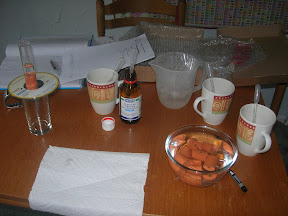
The task, should we decide to accept it - and the fact it will be examine in the mandatory TMA-2 is a good indication that one should, is to look in detail at the breakdown on hydrogen peroxide into water and oxygen. There is a enzyme catalyst for this reaction found in many living cells, as it is part of the chain that disposes of oxygen free radicals. In this case, we're going to get them from a simple source, the humble potato. The experiment also involves buying some H2O2 which causes some interest. This is one of the alleged substances that the terrorists were planning to use in their liquid bombs, so a raised eyebrow is not uncommon when asking for some at a chemists.

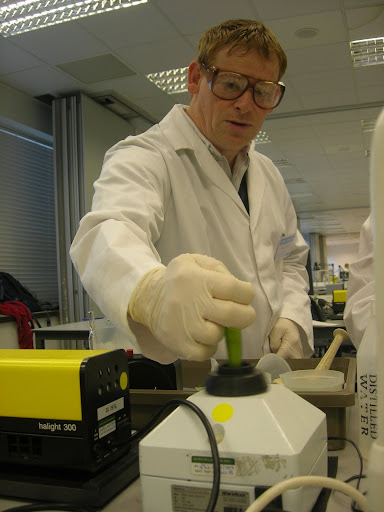
We have been sent an experimental kit, which consists mostly of test tubes with rubber bungs and glass pipes in them. Also supplied are pipettes and safety glasses. I elected to wear the glasses in the first part of the experiment as I'm sure it made me look more like a proper scientist.

The potato has to be liquidised to get at the enzyme, and then left to separate into a rather unappealing mess. Also the hydrogen peroxide, various containers of water and a stopwatch are required, as is a notebook to record all the results.

Experiment one is to try and find a mixture of this potato juice, water and hydrogen peroxide that reacts at a reasonable rate. Not so fast that it sprays all over the kitchen, and not so slow that it drips at an uncountable rate. It takes a bit of practice to assemble the components in a timely manner so that drips can be counted, that give an indication how fast the breakdown is occurring.

Experiment 2 is to repeat the experiment a number of times with the chosen mixture, and see at what time the peak production occurs.

Experiment 3 looks at varying the concentration, under the hypothesis that concentration does affect the rate of breakdown.

It is deadly boring counting the drips towards the end, especially on the control samples where nothing much happens. By the end of the set of experiments I'm a little less enamoured of potatoes and their extracts than I am at the start, but I have gathered some results at least, which will come in useful.

Thursday, 22 February 2007

S204 - TMA-1

Its time to look at the first TMA. I have to admit to a bit of nerves facing this first one.
Its my first 2nd level course, and the workload is more than in S103, so I'm not really familiar with the territory.

There are just two questions - which is nice.

  1. Question 1
    1. The first question is in three parts and is focused on taxonomic detail.
      We are asked to use the GLO to give the full taxonomic tree of two organisms. This means things like family, phylum, class, order, genus and species, and sometimes things in between.
      The GLO is in the Guide to Living Organisms which is a computer program supplied with the course. It is basically an interactive encyclopaedia of organisms that you can search. It has details about various levels and includes pictures and other facts of a large range of organisms.
    2. The second part of question 1 is to produce a table listing details about the four different phyla of gymnosperms. This involves a fair bit of searching through the GLO for information.
    3. The final part of the 1st question is to compare particular aspects of gymnosperms.


  2. Question 2 - write a report discussing "Biodiversity in large or complex protoctists".

    Ok - this is the big one for me. You are allowed 1000 words to write the report. Diagrams and pictures are encouraged. References are essential, as are example organisms.


I have to say this whole question takes me several weeks in total. Question 1 (a) I found reasonable easy after getting to grips with the GLO. Question 1(b) was a bit harder, as often it was difficult to find the same level of detail about each phyla. You might find data on, say, how high typical species of the phyla grew for say the conifers, but it was missing for one of the other phyla. 1 (c) seemed a little easy, which worried me that I wasn't understanding it correctly.

Question 2 took the most time, as I kept coming back and adding examples, tweaking diagrams, rereading the question notes to see if I was including everything. Its funny how these essays go, I usually write less than required, rather than more. So I crept up to the 1000 word limit. 500, 700, 750, ... 900, 1100! Wow what happened, finally as I approached the 1000 words, I overshot suddenly, and I still wanted to expand the intro/conclusion.

As I got nearer the deadline, and was reasonably happy with the way things were looking, I suddenly had doubts that the way I had approached the question was not consistent with some of the notes on answering it. Should I throw this away and start again?
In the end I stuck with what I'd done, not having the energy to try again. I handed in the completed answers at the first tutorial, that way knowing it wouldn't get lost in the post!

Saturday, 10 February 2007

S204: Tutorial

First tutorial for S204 - and although its close by it takes me a while to find the actual location.
When I do there is only one other student and the tutor, and that turns out to be all that attend.

The tutorial starts off with a simple test of logic problems, like
"There is a house with four windows. There is one window on each side of the house. All the windows face South. A bear runs in front of one of the windows. What color is the bear?"
Its a trick question - the bear is white as the only place the house can be is on the north pole. The idea was to get you thinking and looking carefully at the question. A lot of people loose marks by not reading the question fully or answering a different question to that written.

The tutor also went over that most scary of prospects, the exam, what parts there were, what you had to do, what was optional etc.
Then a quick bit of practice at writing a precis of an article, and finally he talks through the statistics we will be using, which is largely the student t-test.
The tutorial is very useful, not from a gaining knowledge perspective, as much as the tricks of the trace answering exam and TMA questions.

Sunday, 28 January 2007

S204: Book 1 - Introduction to diversity

Book 1 of the S204 course is all about diversity. It covers quite a lot of taxonomy, the science of categorising living things. Now if there is one thing that taxonomists agree on, its that almost every part of the taxonomic tree is subject to disagreement.

The next part is about protoctists, what probably use to be called protozoa. Its those organisms that aren't bacteria, plants, animals or fungi. So its a bit of a mixture.

Finally the last part of the book looks at common laboratory organisms, such as rats, C. Elegans, zebra fish etc.

Its not the most exciting of books for me, though it is luckily fairly short at 138 pages or so.