Google
 

Thursday, 27 May 2010

S366: The book

As I've said, this course is a combination of two books. The text book that comes with it, and the companion text which tells you which bits to read. Sometimes this directs you to read a whole chapter, sometimes just bits and the companion text then has lots of text to read that replaces or supplements that in the text book. So what do we do in this course? Well here are the first few chapters. All labelled with letter of the alphabet.

Section A Evolutionary biology - this is an introduction to evolution. Where it stands, what its principles are, how secure it is etc. Sets the scene nicely.

Section B Adaptation - here we look at some examples of adaptation. It includes a DVD video on Adaptation in Svalbard reindeer. Some reindeer that are unique to a small island, which has influenced their evolution.

Section C The Tree of Life: classification and phylogeny. Lots of stuff on constructing cladograms, and phylogenetic analysis. Several exercises to do here, some stuff for TMA 1 too.

Section D Patterns of evolution - more on phylogeny, and a look at trends and adaptive radiation.

Section E Evolution in the fossil record - some examples including the origin of feathers and the ancestry of birds. A look at fossil trends, punctuated equilibrium, and this is where the brachipod stuff fits in.

Section F A history of life on Earth - From Earth’s earliest life, through evolution in the precambrian to evolution in the more recent eras.

Section G The geography of evolution - looking at geographical influences, barriers, climates, ecologies.

Section H The evolution of biodiversity - which looks at how to quantify taxonomic diversity, mass extinctions, and so on.

Section I The origin of genetic variation and Evolution of genes and genomes - here we look at genes and genomes, how mutations occur and the randomness of it. Also things like recombination, the origin of new genes and then some parts on the phylogenetic processes applied to genes.

Section J Variation - Distinguishing sources of phenotypic variation, some work on population genetics, molecular markers and qunatative traits. Some maths involved here.

So - thats about half the course.

Next S366 Prev S366

Tuesday, 25 May 2010

S377: Book 2 - The Dynamic Cell (Vol 1)

This is the 2nd book of the S377 course.

We start to get into a lot of the cellular stuff here. The chapter numbers follow on from the first book - so it starts with Chapter 7.

Chapter 7 - Introducing the Dynamic Cell is quite brief, and is an introduction to the cell and its contents. Nothing particularly new here, but it sets the scene.

Chapter 8 - The Cell Cycle is much more in depth. We cover the mechanisms of mitosis, the cell cycle meiosis and cell division. However this is in quite gory detail. I'm sure many people have seen videos of chromosomes lining up and then separating to opposite ends of the cell. All very nice, I've even seen it under the microscope, although of cells caught in the act rather than dynamic. However you have to ask here, how do the chromosomes move around, how do they pair up, how do they line up? What causes them to separate and how does the cell arrange for it to happen without error.

Chapter 9 - DNA Replication and Repair - again something I've covered many times before. However not in this detail. The typical animated image shows DNA unzipping and getting copied just like that. However its a lot more complicated than that. For instance as the strands separate under the influence of a enzyme, the twisted nature of DNA means that further up the molecule it starts to get all twisted and under tension . Its like unwinding the strands of string, as you pull them apart if starts to ravel up further down. DNA is also often packed up into compact structures, which have to be unpacked before you can even start the replication. Then there is the problem of replicating the lagging strand, the fact that to replicate something like human DNA in any reasonable time you have to have lots of replication at the same time doing different bits, that then all have to get joined together. Yes - its complicated. Then there is repair...

Chapter 10 - Gene Expression - this chapter is all about how genes are switched on and off. Lots of stuff on operon, enhancers, silencers and so on. The infamous Trp operon is considered.

Chapter 11 - Translation and Protein Turnover - the last chapter of this book. Considers how the ribosomes work, how they match the tRNA to the mRNA, and how the tRNA gets the right amino acid attached to itself - again something normally skated over. There is also alternate splicing, mRNA regulation, post transcription modification, nuclear export - lots of details here.

Some fascinating stuff here - and some stuff that is not too well understood.

Sunday, 9 May 2010

S377: TMA-1

The first TMA of the course - and its a long time until the submission date. Given I started the reading before Christmas, the April submission date is a long way in, and I've read past most of the relevant material, so some rereading is required.

So there are 5 questions to answer.
Question 1 is about enzyme structure. It looks at a kinase and you have to make some general comments on structure, domains and function.

In Question 2 we have to look at a 3-d molecular model and identify and measure parts of it. There are also tasks to perform. Also required is to include an image of the enzyme active site.

Question 3 simply gives you some concentration data and asks you to work out the equilibrium dissociation coefficient of a ligand and its receptor. The question is a little sparse as it doesn't really give much guidance on what is wanted in the answer except the value.

Question 4 is about SDS-PAGE and requires you to run gels on the computer simulation with a number of kinases and antibodies to work out what the results tell you.

Question 5 is all about reading scientific literature. You are given a piece of writing and then have to make sense of it and answer a number of questions about what its conclusions are.

Not a bad TMA in some ways - but a little disappointed with the mark I get.

Saturday, 17 April 2010

S366: TMA-1

So - time for the first TMA. Its quite a long way into the course, so you have a lot of time to devote to it if you want - or alternatively to ignore it!
So whats in this TMA?

Well - first thing to say is its big! Its 12 pages long, and for 3 questions thats quite a lot.

The first question is all about phylogenies.
First you have to identify a range of features in a sample, preparatory to doing an analysis on it.
Next you have to look the cladogram of these species and pick out some features in it.
Then you have to indicate the most parsimonious transitions on the diagram, which means finding the transition points for the 10 different features being considered.
Then there is more commentary required on the shape of the cladogram, and what this says for the inter-relatedness of the species.
The next step is to input the characteristics into a program, and perform your own cladogramatic analysis.

The next question is about statistical analysis - and it brings in the home kit.
A while lot of work is required to analyse some given data, and relate it to the data you have worked out from the home kit. There is a log of statistical manipulation required here. None of it is hard, but one figure feeds into the next, and its easy to make a mistake - subtract rather than add, or pick the wrong figure to divide by.
A couple of graphs have to be drawn or amended, and then commentary has to be made on the results and what they show of the species and now they are related. Whether their growth patterns are similar. You also have to make some predictions on what this might mean if you found new samples.

Finally question 3, which is 10% of this, is a SWOT analysis of each of the potential projects that need to be undertaken for the next TMA. It also includes a risk analysis section, which I struggle to take seriously, but complete through gritted teeth!

The course team reckoned 5 hours to complete the TMA, I wouldn't like to think how long I spent on it though.
Next S366 Prev S366

Thursday, 15 April 2010

SXR375: Plants and Pigments

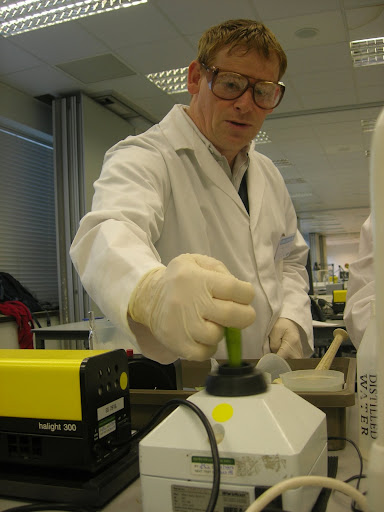
So yesterday a parcel arrived - it has in it the material for my next residential school coming up in July.
This is a 3rd level course investigating plants and pigments.

It arrives with
  • A folder
  • A folder insert
  • A course description
  • Some prereading material
  • A DVD
The school is all about analysis of plants and the way they use pigments to control their photosynthesis and manage energy and light issues. There is a computer marked multi choice paper that has to be done before hand (online) which you have to pass to complete the course.

Then there is the school itself, which includes presentation of results, and then a write up to do afterwards. Looks to be fun, and this time I have to take my own lab coat, so have ordered one.

Sunday, 7 February 2010

S366: The brachiopods measure up

So - with the arrival of the practical kit, and the appropriate part of the course reached. Its time to do some practical stuff. So here we are - presented with 30 plaster casts of various brachiopods, all from the same era.

My task is to measure them with the supplied calipers. They are accurate to about 0.1 mm although I suspect most of the error measurements comes from how you actually attempt the measurement. For each of the 30, I have to measure and record the length, width and thickness of them. Now you might think this is simple enough, and I suppose it is, until that is you offer up the first sample to the jaws of the vernier calipers. Width is perhaps the easiest, as there is really only one width, and the only trick is making sure the sample is perpendicular to the jaws to get a true reading. Length is next easiest, but you have to do it in the right orientation otherwise off axis sticky out bits tend to make it seem longer than it is. Thickness is more tricky, as the thickest bit on one side is not opposite the thickest bit on the other. Therefore you have to make sure the "seam" is appropriately flat to the jaws and you haven't got the whole thing crooked.

All simple enough really, but rather than sitting down at a table in a good light with sharpened pencil and pad, I find myself sliding into the event sitting on a settee with the TV on (Horizon) and dispensing with the pencil altogether and recording straight into excel. Is laziness ever a virtue I wonder? Its certainly much easier to read my writing back afterwards, so maybe it is. I'd planned the well lit desk I think, but just somehow drifted into the first measurement, oh well...

With the results recorded there is now a whole heap of stats to apply to the numbers to see if there is a correlation at all, if there is a relationship between the three dimensions, and then finally how they compare with some brachipods from a slightly different era. The calculations are not hard really - as either excel or a supplied program can do them, but they are fiddly. There are quite a number of them, and its quite easy to divide one number by the wrong one at some point which means the final answers are way out of line. It takes another night, and a fresh look at the calculations to have any confidence that the chain of about 20 results really do end up with something sensible. I mean, does -6.2 sound about right to you?


Next S366 Prev S366